
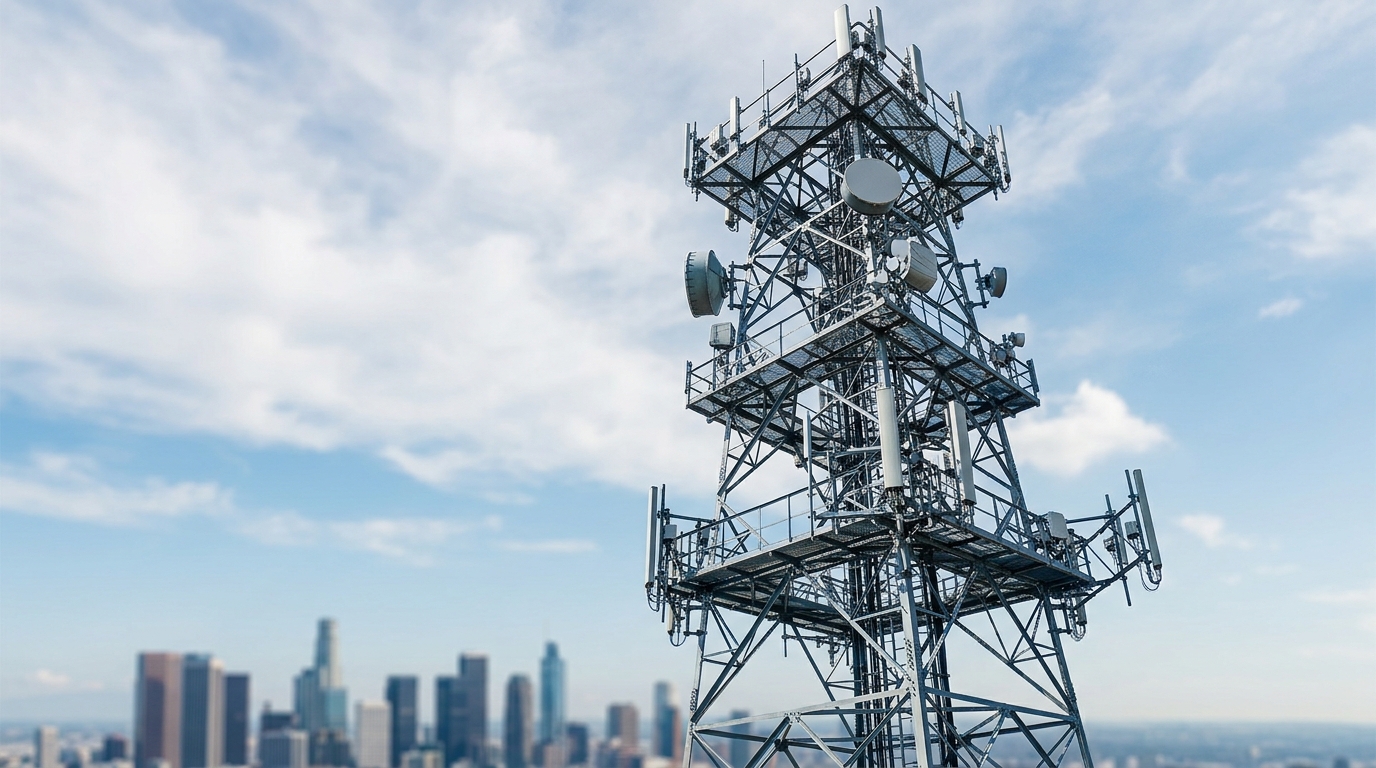
Friday produced one of the cleaner market verdicts of the year. Crown Castle jumped 15.6%, American Tower 9.3% and SBA Communications 7.3%, while AT&T, Verizon and T-Mobile, the tower companies’ three biggest customers, all fell. The same deal drove both directions simultaneously. That is not noise. That is the market saying something specific about who captures value in a restructured wireless industry.
The catalyst was SpaceX’s agreement to buy spectrum it cannot fully deploy from space. SpaceX agreed to acquire up to 14 MHz of paired 800 MHz spectrum from Grain Management, the private equity firm that assembled the nationwide holding. The Wall Street Journal reported the price at about $8 billion in cash. The deal requires FCC approval. SpaceX said the 800 MHz licenses will provide “a coverage layer that penetrates walls and serves devices indoors,” and that Starlink Mobile will combine its satellite constellation with “an advanced terrestrial network.” That last phrase is the one that matters for CCI, AMT and SBAC.
Low-band coverage spectrum is hard to use from orbit and easy to use from a tower. The 800 MHz band travels far and punches through walls. A satellite sitting hundreds of miles overhead cannot replicate that at meaningful scale indoors. So investors concluded that if SpaceX is serious about becoming a mobile carrier, it needs ground infrastructure. And ground infrastructure means tower leases.
Bernstein put numbers to the option. In a note to clients Friday, Bernstein said the deal keeps a SpaceX ground-network build “very much alive” and gives the company what it needed “to make that option more credible – and less expensive.” The firm’s base-case scenario, modeled before the deal was announced, assumed exactly this spectrum acquisition. That baseline envisions roughly $70 billion and 57,000 macro sites over an approximately eight-year build period. Even the lighter Metro scenario, under Bernstein’s modeling, would require 32,000 macro sites and take 5.7 years to build. At either scale, Crown Castle, American Tower and SBA are the ones with the sites.
The revenue math is what Friday’s rally was really pricing. Analysts expect Crown Castle’s revenue to reach about $4.2 billion by 2028, so a SpaceX build would represent growth their estimates leave out entirely. AT&T, Verizon and T-Mobile were expected to generate approximately 90% of Crown Castle’s 2025 site rental revenue, so any new rent-paying tenant is consequential, and a tenant deploying 57,000 sites would be transformational.
The counterpoint deserves equal weight. Bernstein cautioned that buying spectrum is not a commitment to build. The firm still views a partnership as the most likely outcome for SpaceX’s mobile business. SpaceX has emphasized femtocells as part of its terrestrial strategy, which would generate far less tower revenue than a conventional macro build. The deal also still requires FCC approval, adding regulatory uncertainty before any construction begins. And the three big carriers that fell Friday are not standing still.
What the carriers’ sell-off confirms is that the market has already accepted SpaceX as a credible competitive threat to AT&T, Verizon and T-Mobile. Reports Friday said the development advances SpaceX’s plans to move beyond supplementing existing cellular networks and compete more directly for mobile subscribers. Whether it validates the tower rally depends entirely on execution that is years away.
Watch for FCC commentary on the Grain transfer, any SpaceX infrastructure partnership announcements, and analyst revisions to tower revenue models. The lease that does not exist yet is what Friday’s move was worth. If it materializes, the move was too small. If it does not, it was too large.