
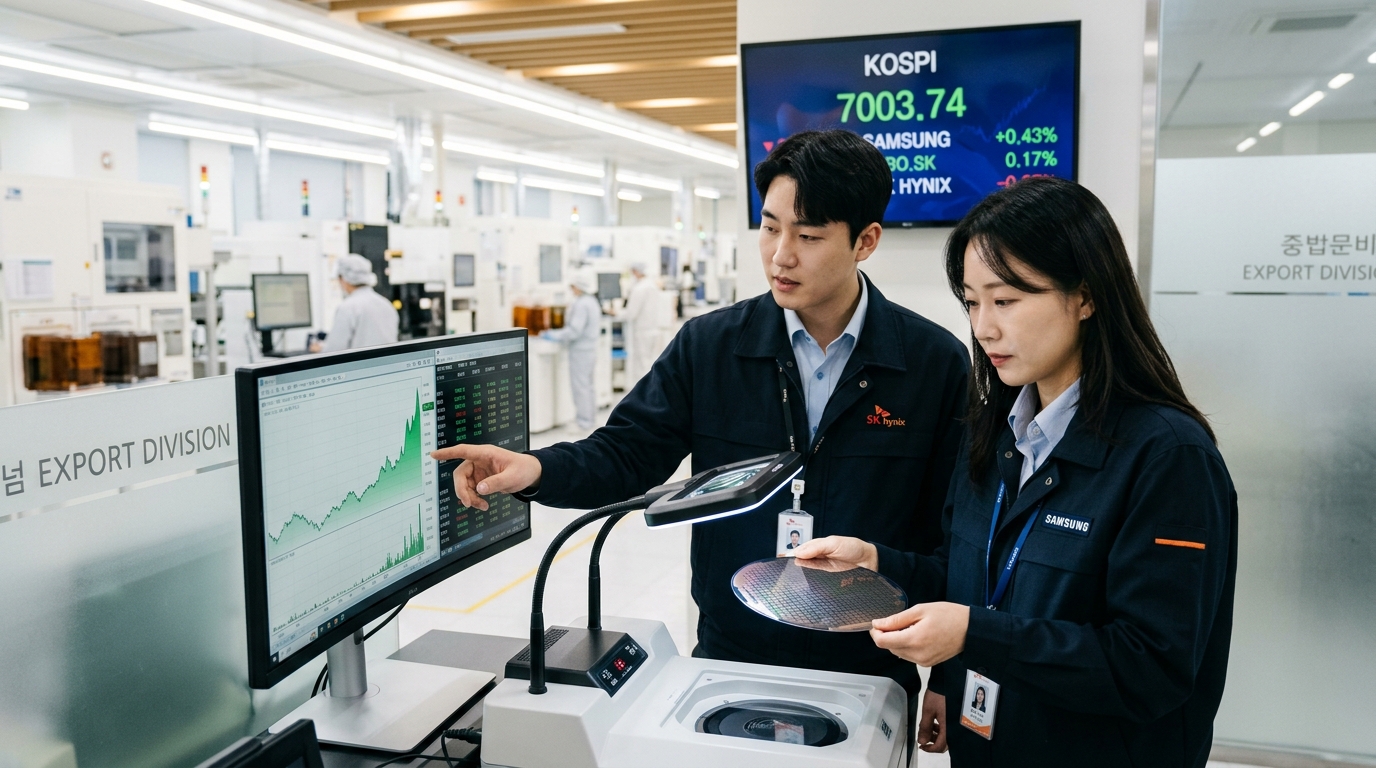
The Kospi closed at 7,003.74 on October 2, up about 97% over the past year. That is not a typo. A developed-market index, one that trades just fine in an ETF most US investors have never opened, has nearly doubled in twelve months, and it did it almost entirely on the back of memory chips.
Market Snapshot
South Korea’s exports jumped 83.5% in September from a year earlier to a record $120.94 billion, as semiconductor shipments more than tripled on global AI spending. Chip exports surged 262.8% to $60.30 billion in September, topping $60 billion for the first time. When the physical trade data hits numbers like that, the equity index tends to follow. It did.
Stocks in Focus
Samsung Electronics rose 2.79% and SK Hynix gained 3.21% on October 1, leading the benchmark index higher. SK Hynix’s move carried a specific message: it rose 3.21% as optimism over tight AI-memory supply supported the rally. The company has reported record second-quarter results, long-term agreements with around 10 customers, and the start of HBM4 mass shipments, with plans to increase HBM4 production in the second half.
For US traders, the read-through lands at Micron (MU). Micron forecast quarterly revenue above estimates and said customers had increased commitments under its long-term supply agreements to $32 billion, signalling unabated demand for AI memory chips. As one KB Securities analyst put it: “Semiconductor shares rallied as Micron projected that memory supply and demand would be tighter in 2027 and 2028 than this year.” That forward tightening is exactly what kept the Kospi bid on Thursday and Friday.
Sector Watch
Memory is the sector. Not semiconductors broadly, memory specifically. South Korea dominates the AI-driven storage boom: SK Hynix is Nvidia’s key HBM supplier, and Samsung leads in consumer DRAM, NAND, and enterprise SSD storage. Samsung’s share of global HBM revenue rose 12 percentage points to 33% in the second quarter from 21% in the first quarter, and analysts say the combination of higher HBM4 shipments and rising contract prices next year creates a structure in which both volume and price feed into earnings simultaneously. That kind of double-lever dynamic is what sustains a rally rather than simply igniting one.
Risk Radar
A near-doubling in twelve months demands a look at what could reverse it. The index has already shown it can move violently in both directions. The Kospi ended the third quarter at 6,838.04, down 19.3% over the period and 25% below its June 22 record close of 9,114.55. Elevated oil prices, persistent inflation and US long-term yields above 5% have eroded the appeal of equities even as corporate earnings stay strong. The index climbed back to 7,003.74 from that hole. Whether it holds 7,000 into the US jobs print matters for Monday’s open in chip names.
The Cheat Sheet
- Top Market Theme: The memory supercycle is no longer a Wall Street forecast, it is showing up in South Korea’s physical export data, and the Kospi is the scoreboard.
- Stock to Watch: SK Hynix (via EWY for US ETF exposure, or MU as the most direct American proxy). Supply contracts are resetting scarcity; both names move on the same fundamental.
- Sector to Watch: Memory chips. HBM4 shipments have started, contract prices are rising, and Micron’s forward guidance pointed to further tightening through 2028.
- Biggest Risk: The Kospi has repeatedly triggered sidecars and circuit breakers throughout 2026, with volatility already topping the 2008 financial crisis record. A roughly 97% year-on-year gain in any index compresses the margin for disappointment to nearly zero.
- One Thing to Remember: The Kospi at 7,003.74 is the overnight confirmation that AI memory demand is translating into real revenue, not just analyst targets. Watch how MU opens Monday, Korea just handed it a data point it could not have bought.