
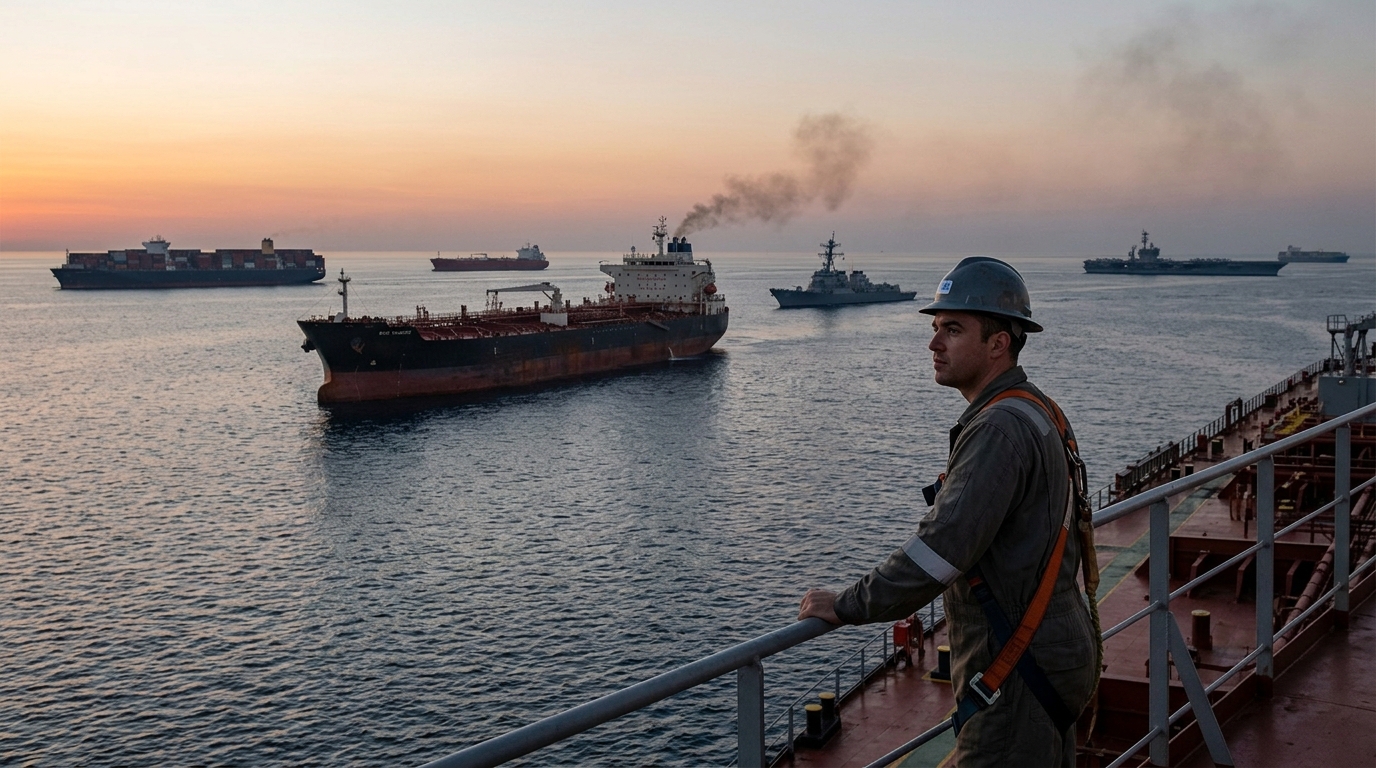
The Strait of Hormuz now has tankers catching fire nearly every other day. Washington has confirmed a third carrier strike group is heading toward the region as President Donald Trump weighs further action against Iran. And Brent crude, after briefly dipping toward $97 this week, is trading back above $102. The question inside every serious investment committee right now is not whether the escalation is real. It is why the oil market treats it as routine.
The Military Escalation Is Unambiguous
The Pentagon is deploying an additional aircraft carrier and roughly 10,000 sailors and Marines to the Middle East, a move that gives American commanders more options if President Donald Trump chooses to escalate attacks on Iran. The USS Theodore Roosevelt, which left San Diego on September 27, joins the USS George H.W. Bush and USS George Washington already in theater. An amphibious readiness group carrying more than 2,000 Marines is also deploying. Officials have described the assembled posture as nearly 20,000 sailors and Marines and up to roughly 150 aircraft, the largest concentration since a three-carrier presence earlier this year.
The attacks on shipping have kept pace with the military buildup. The tankers struck this week included the oil products tanker Al Ruwais and the VLCC Mersin Prosperity, both managed by ADNOC Logistics and Services of the United Arab Emirates, as well as the Aframax-sized tanker Sinbad, managed by Anglo-Eastern Tanker Management. Some vessels have been moving through the strait with their Automatic Identification System transponders turned off to reduce tracking. Then on October 1, a fourth vessel was struck. UK Maritime Trade Operations issued Warning 147-26 after receiving a third-party report that a tanker was hit at about 1750 UTC, resulting in a fire onboard. The crew was reported safe. Late reporting has been a feature of this conflict. UKMTO also issued late reports covering multiple incidents from September 28 and 29, a reminder that the public log of strikes can lag what is happening on the water.
The Bull Case: The Market Already Knows the Worst
The reason crude is not spiking past $120 is not complacency. It is adaptation. Crude transiting Hormuz reached a seven-day average of 13.5 million barrels per day as of Monday, matching a prewar baseline for shipments through the strait, according to Kpler. Gulf pipelines are carrying far more oil around Hormuz than before, with Kpler putting it at about 40% of regional crude now bypassing the strait versus roughly 17% before the war. Ship-to-ship transfers and convoy-style movements have also become part of the operating playbook.
JPMorgan commodity analysts have argued that higher crossings should not be mistaken for improved safety. Rather, they reflect the industry’s increasing ability to operate under sustained risk. That is the bull case in a single line: producers have engineered around the conflict, so the supply shock the market feared in February has not materialized at the crude level.
The Bear Case: The Recovery Is Thinner Than It Looks
The crude flow numbers obscure a serious fracture underneath. Refined products shipped through Hormuz are at a seven-day average of 677,000 barrels per day compared with roughly 3.6 million barrels per day before the war, according to Kpler. The crude-versus-products split matters because refinery margins eventually feed back into crude demand, and because the diesel squeeze is already forcing policy responses, including Trump publicly weighing a ban on U.S. diesel exports.
The more uncomfortable read is structural fragility. The delayed incident reports highlight the growing gap between attacks occurring in the Strait and when they become part of the public record. UKMTO reporting relies heavily on vessels and operators voluntarily passing information to maritime authorities, meaning publicly available warnings should not be treated as a complete accounting of events. The official count may be understating actual incidents by a meaningful margin. And Trump has publicly weighed further pressure on Iran versus a negotiated reopening of Hormuz, with U.S. midterm elections on November 3, 2026 in the background, a political clock that compresses the window for resolution.
What Investors Are Missing
The oil market is pricing a functional status quo. The defense market is pricing a war that is far from over. Those two readings cannot both be fully right. The Pentagon has moved aggressively on multi-year munitions production. RTX has disclosed a $20.7 billion multi-year award tied to accelerating AMRAAM production, and Raytheon has also publicized a separate $24.4 billion multi-year SM-6 award as the U.S. works to replenish stocks. Meanwhile, the Army awarded Lockheed Martin a contract modification that lifts the PAC-3 MSE multiyear ceiling to about $58.62 billion for fiscal years 2026 through 2032. Munitions spending at this scale does not reflect an administration expecting a quick diplomatic exit.
The hidden risk for the crude-flow optimists is that the pipeline-and-escort system holding Hormuz together is not resilient. It is improvised under fire. A single successful strike that again takes Saudi Arabia’s East-West pipeline offline, which was temporarily shut earlier this month after being damaged in a drone attack that Saudi officials said originated from Iraq, would remove the infrastructure that makes the current flow figures possible. At that point, Brent at $102 would look like a very cheap option premium on a much larger disruption.
Stocks to Watch
ADNOC Logistics (ADNOCLS): Two of its managed vessels were among those struck this week, and ADNOC has previously confirmed that 15 of its vessels have been targeted since the conflict began. The recurring targeting of UAE-linked tonnage carries specific reputational and operational risk beyond the sector average.
Frontline (FRO) and International Seaways (INSW): Frontline reported adjusted earnings of $2.61 per share for Q2 2026, up from $0.36 a year earlier. VLCC rates for Hormuz-linked voyages have surged, with multiple shipping-market reports putting fixtures and benchmarks above $1 million per day at points in September. Both names are clear beneficiaries of the tonne-mile expansion and risk premium, but also fully exposed to any ceasefire that normalizes rates overnight.
RTX and Lockheed Martin (LMT): RTX reported a record backlog of $289 billion as of Q2 2026. The multi-year contract cadence coming out of Washington is not a one-cycle event. As long as the Strait remains contested, both companies are selling something the Pentagon cannot afford to run short of again.