
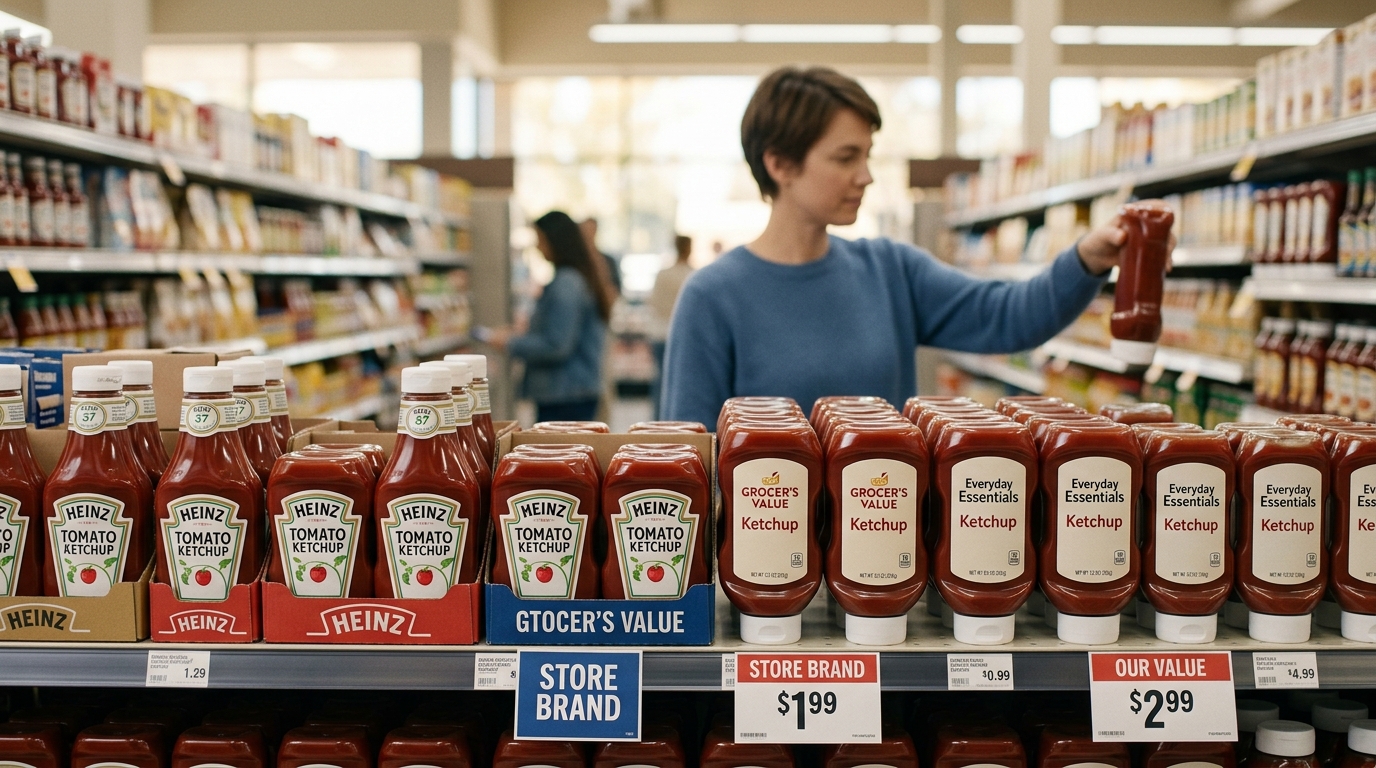
The economics are no longer subtle. Retailers carrying national brands on their shelves earn gross margins that are typically in the mid-20% range. When a shopper reaches past the Heinz ketchup and picks up the store label next to it, the grocer’s margin can be meaningfully higher. That gap is not an accident. It is a strategy, and it is compounding.
- Private-label dollar sales hit $330B, capturing 24% of U.S. unit sales and 23% of dollar sales, per Circana data.
- Kroger’s Our Brands represented over $39B of sales in 2025; Simple Truth previously crossed $3B in annual sales and remains one of its flagship own brands.
- Walmart is refreshing nearly 10,000 Great Value items across food and consumables, calling it the most extensive private brand update in the company’s history.
- Conagra’s Q2 fiscal 2026 reported net sales fell 6.8% year-over-year to about $3.0B; non-cash goodwill and brand impairments were $968.3M and drove a large reported operating loss for the quarter.
- Kraft Heinz announced a $600M reinvestment plan across Marketing, Sales, R&D and product superiority to support a U.S. recovery effort; its 2026 outlook also implies a mid-to-high teens decline in adjusted operating income.
- 71% of consumers select their preferred retailer based on the strength of its private-brand program, per Advantage Solutions and Daymon summer 2026 data.
- Private-label growth is projected at 6.6% CAGR through 2028, per Strategy& (citing Technavio), roughly double the expected overall grocery retail growth rate.
The Shelf Is Not Neutral Territory
Kroger’s Our Brands program is now explicitly scale. Kroger says Our Brands represented over $39 billion of its sales in 2025, and Kroger’s own consumer-facing Our Brands page puts the assortment at 13,000+ items. Kroger also highlights a national manufacturing footprint (reported as 32 food manufacturing facilities). In a business where total gross margins run about 22% to 23% (Kroger reported 22.9% gross margin for full-year 2025), that mix shift is decisive.
Walmart’s posture is even more direct. The company is mid-overhaul of its Great Value lineup, refreshing nearly 10,000 items across food and consumables. Great Value household penetration sits at 86% of U.S. homes, based on consumer panel data that has been reported publicly. That is not a side business competing with national brands. That is the category.
What the CPG Earnings Signal
Conagra’s Q2 fiscal 2026 results laid out the arithmetic of losing. Reported net sales fell 6.8% year-over-year to about $3.0 billion, while organic net sales declined 3.0%. The company booked $968.3 million of non-cash goodwill and brand impairment charges, and its earnings release showed those charges were the primary driver of the quarter’s reported operating loss.
Kraft Heinz’s trajectory is structurally similar. The company has framed private label and changes in consumer demand as persistent pressures in the U.S. center store, while also pointing to the impact of benefit changes and other macro headwinds. It has announced a $600 million reinvestment plan across Marketing, Sales and R&D and related capabilities, and its 2026 outlook implies a mid-to-high teens decline in adjusted operating income as those costs flow through. When the owner of Oscar Mayer and Philadelphia Cream Cheese takes that kind of near-term profitability pressure to defend shelf position, every retailer negotiating with that supplier holds more leverage than at any point in the past decade.
Technical Levels and Positioning Framework
Kroger (KR) has established support near the $58–$60 range through 2026, with resistance at the $67 level corresponding to early-2026 highs. The stock remains above its 200-day moving average, supported by private-label momentum and retail media revenue growth. Volume patterns on earnings days reflect institutional accumulation on private-label beat quarters. Conagra (CAG) has traded below its 200-day moving average since the Q2 impairment quarter, with the $27–$29 zone offering near-term support contingent on no further guidance revision.
Scenario Modeling
Bull Case (Retailers): Kroger and Walmart sustain private-label penetration gains of 0.5–1 percentage point annually, driving gross margin expansion of 20–30 basis points per year. Kirkland Signature, often described as accounting for roughly a third of Costco’s sales and estimated at about $86B in annual sales, compounds into a loyalty moat that is difficult for national brand promotional spend to offset. KR trades toward $72.
Base Case: Private-label unit share grows 0.2–0.5 percentage points in 2026, consistent with industry commentary. National brands stabilize via incremental promotional concessions and slotting fee agreements, buying shelf survival at the cost of margin. CAG trades rangebound at $28–$33 while Kraft Heinz execution determines whether portfolio actions can sustain a valuation premium.
Bear Case (CPG): Retailers accelerate SKU rationalization, reducing center-store branded facings by 10–15% across top categories. National brands face a feedback loop: fewer facings, lower turns, weaker negotiating position, higher slotting demands, further margin compression. CAG tests $24 support; KHC’s post-separation North America grocery exposure trades at discounted multiples if volumes fail to stabilize.
Active Trader Strategy Framework
The margin arbitrage is the structural thesis. Retailers have every financial incentive to expand private-label shelf allocation, accelerate SKU development, and use slotting and promotional fee structures to keep national brands funding the very traffic that now converts to store-brand sales. Monitor Conagra’s next earnings cycle for any volume stabilization in frozen segments as the tell on whether brand reinvestment is holding. Watch Kroger’s gross margin trajectory: a sustained move above 23% would confirm mix and execution are flowing through. Risk management demands defined stops, because sentiment in legacy CPG can shift fast on M&A speculation or commodity relief rallies that change the calculus temporarily without changing the structure.
The shelf is the battlefield. Retailers are winning it by design.