
The semiconductor sector spent Thursday nursing a 3.4% loss after a report put OpenAI’s annualized end-of-September revenue near $50 billion, roughly $20 billion short of what earlier widely circulated figures had suggested. Nvidia-backed data center operator Firmus pulled its planned $5 billion IPO the same day after investors balked at the valuation, the debt, and the ambitious buildout plans of a company operating just two data centers. A rough 48 hours for the AI complex, no argument there.
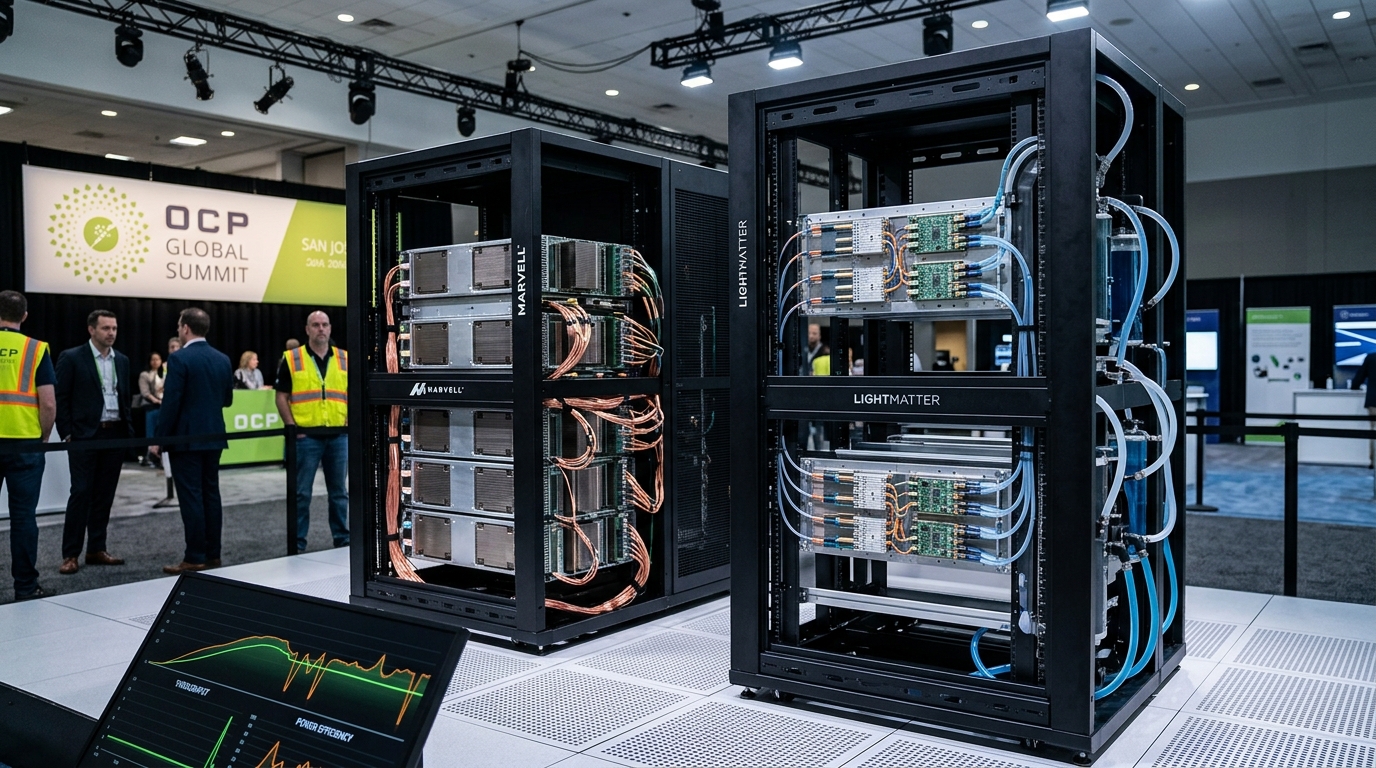
But the calendar has a response. The 2026 OCP Global Summit runs October 12 through 15 in San Jose, under the theme “Scaling Innovation for the AI Era.” Registration is sold out, with no onsite option available. This is where hyperscalers, chipmakers, and systems integrators converge to write the specifications that govern how 2027 racks get built: power delivery, interconnect standards, optics integration. The specifications agreed to here can become purchase orders twelve months from now.
Two names deserve close attention this week, and they are not Nvidia.
The Case for Marvell
Marvell has executives and engineers scheduled to deliver 14 sessions across the four-day event. The company plans to present solutions for switching, interconnect, memory expansion, storage, optics, and data center security, all focused on open, standards-based AI infrastructure. That breadth matters at OCP: companies that help write the spec tend to ship the silicon that implements it.
The financial backdrop supports the ambition. Marvell posted record second-quarter fiscal 2027 revenue of $2.739 billion, up 37% year over year and $39 million above the midpoint of its own guidance. CEO Matt Murphy cited a 46% year-over-year acceleration in data center revenue and said AI-related bookings remain robust.
The NVIDIA relationship amplifies this. On March 31, 2026, NVIDIA and Marvell announced a strategic partnership connecting Marvell to the NVIDIA AI factory and AI-RAN ecosystem through NVLink Fusion. NVIDIA backed the partnership with a $2 billion investment in Marvell. That is not a vendor relationship; it is a co-development agreement backed by real capital, and it gives Marvell’s OCP sessions this week an audience that will be paying close attention.
One honest caveat: management has indicated that some large hyperscaler opportunities can be back-end weighted, which can create a gap between the near-term growth cadence and the timeline for the largest programs to fully ramp.
The Case for Lightmatter
Lightmatter is presenting a different kind of bet at OCP, and it is structurally more interesting for investors who want exposure to where AI interconnect is heading rather than where it is today.
The Open Silicon Photonics for AI Systems initiative launched as an official workstream within OCP in August, with Lightmatter leading the effort. The initiative published a roughly 300-page foundational white paper aimed at scaling OCP cluster environments from 72 nodes to more than 1,024 nodes while supporting multi-vendor interoperability. The urgency is physical, not theoretical: as scale-up domains expand across multiple racks and SerDes rates approach 448G, copper’s reach shrinks to tens of centimeters, forcing a shift toward all-optical fabrics.
First specifications from the initiative are expected to be submitted in the fourth quarter of 2026, which means the OCP summit this week is Lightmatter’s chance to move that timeline from white paper to formal standard. At the summit, Lightmatter is presenting its open silicon photonics architecture as a critical solution for co-packaged optics as AI workloads push bandwidth, power, and integration limits.
Lightmatter remains private, so direct equity exposure is not yet available. That makes this an OCP summit worth watching rather than a trade executable today, unless you view the session outcomes as read-across for listed names with silicon photonics exposure.
The Bottom Line
Marvell is the investable name with cleaner access to 2027 infrastructure spending. Its 14 sessions at OCP, the NVIDIA NVLink Fusion partnership, and a record second-quarter fiscal 2027 make it the more actionable choice heading into a week where the standards being set directly favor its product portfolio. The risk is that some of its biggest payoffs are back-end weighted, and a market that just sold off 3.4% on an OpenAI revenue reset is not feeling patient.
Lightmatter is the one to watch over a longer arc. If its co-packaged optics workstream clears the specification threshold this quarter, the company would have a strong claim on foundational architecture for next-generation AI cluster interconnects. That is a different kind of win than Marvell’s, and a potentially larger one. For now, Marvell is the trade. Lightmatter is the thesis.