
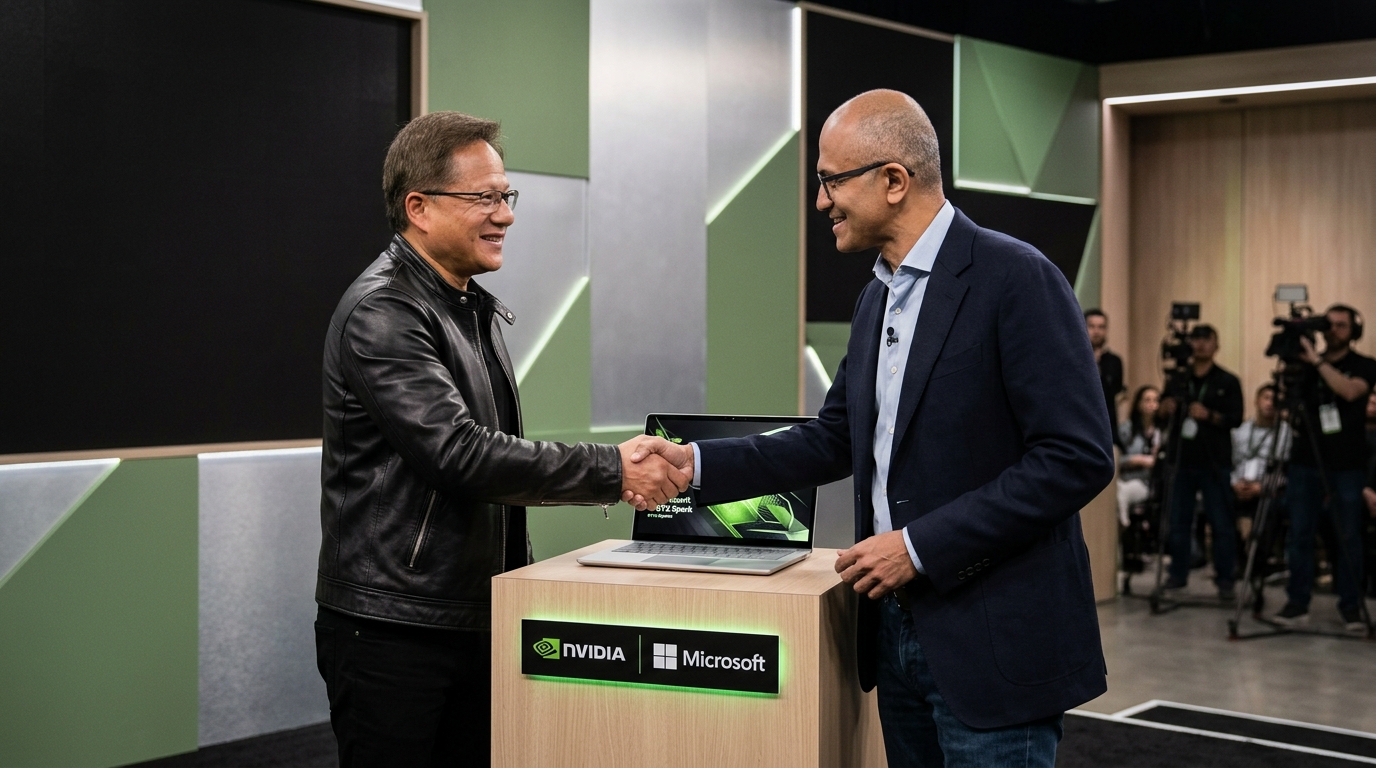
Jensen Huang sharing a stage with Satya Nadella in San Francisco on Tuesday was not just a product moment. It was a signal about what Nvidia is becoming.
Microsoft’s Surface event on October 7 revealed the Surface Laptop Ultra powered by Nvidia’s RTX Spark chip, and preorders went live the same day. The device starts at $2,599, with shipments expected to begin October 16. From a hardware standpoint, the specs are legitimately striking: at the core is the RTX Spark superchip, pairing an Arm-based Grace CPU with up to 20 cores alongside a Blackwell RTX GPU with up to 6,144 cores. With up to 128GB of available unified memory, the system can run large language models with tens of billions of parameters entirely on-device.
Why This Stock Now
The knock on Nvidia through most of 2026 has been concentration. As of the quarter ended July 26, 2026, Nvidia’s data center segment accounts for roughly 92.5% of its revenue, making it exceptionally vulnerable to what appears to be an inevitable slowdown in data center build-outs. RTX Spark is the company’s answer to that concern, and the Surface Laptop Ultra is its most visible proof point yet.
Nvidia built its market value on GPUs sold into other companies’ PCs and servers. With RTX Spark, it is shipping its own processor into laptops and compact desktops for the first time at consumer scale. That is a genuinely new chapter, not a product refresh.
The Business Case
At the Surface and Windows event, Microsoft drew comparisons to the MacBook Pro and said RTX Spark systems can be up to 2.1 times faster on time to first token versus a MacBook Pro 16-inch with M5 Pro. Whether those benchmarks hold up in everyday use matters less right now than the competitive framing: Nvidia is now explicitly competing against Apple Silicon, not just alongside it.
The Surface Laptop Ultra will be joined by a wave of RTX Spark systems from Asus, Dell, HP, Lenovo, and MSI. That OEM breadth is the real story. Microsoft’s device is a flagship reference point; the volume comes from the broader ecosystem.
Nvidia says RTX Spark delivers up to 1 petaflop of AI performance in FP4 precision, putting it in direct competition with Apple’s M5 and Qualcomm’s latest Snapdragon X chips. For Qualcomm, the threat is acute. Nvidia can leverage its reputation as the top AI GPU maker to gain ground against Qualcomm, which integrates its own Adreno GPU into Snapdragon PC processors. Qualcomm’s chips can handle casual games but are not built for heavy AI applications like Nvidia’s RTX GPUs. That is bad news for a company desperately trying to diversify away from smartphones.
Why Wall Street Is Paying Attention
The stock has recovered sharply from a rough start to the year. Nvidia hit an all-time intraday high of $243.37 on October 6, 2026, with shares up roughly 28% in 2026.
The financial foundation backing that optimism remains formidable. Trailing revenue stands at nearly $303 billion with gross margins at about 74.7%. Those are data-center economics. The consumer PC market rarely generates anything close.
What Could Go Wrong
That margin question is the one investors should not skip. For a company accustomed to data-center economics with extraordinary gross margins, consumer hardware is structurally a thinner-margin business. RTX Spark could expand Nvidia’s addressable market meaningfully while diluting the blended margin profile that supports its valuation.
Software compatibility is a real friction point too. The issue is broader app compatibility: while many apps run through Windows’ Prism emulator, full performance will generally be limited to Arm-native software, particularly those tuned for RTX Spark. Premium buyers who discover that caveat after spending $3,000 or more will not quietly move on. And at $2,599 to start, the platform still needs pricing to come down over time to reach mainstream adoption.
The Bottom Line
The Surface Laptop Ultra makes Nvidia a consumer hardware story for the first time at meaningful scale, and that is genuinely additive to the investment case. It widens the addressable market, reduces the data-center dependency that has weighed on the stock’s multiple, and positions Nvidia against Apple in a way that generates headlines and developer interest simultaneously. As AI PCs become the standard, Nvidia’s high-end RTX GPUs are seeing renewed attention in the consumer market. That renewed attention now has a flagship product behind it.
The risk is that consumer hardware economics eventually show up in the margin line, and at a forward P/E near 20 times on surging earnings, the stock is priced for continued execution on both fronts. Nvidia is the most compelling single-stock AI idea available today, but investors buying here are betting the consumer hardware expansion adds revenue without meaningfully eroding the margins that make the valuation defensible. That bet is reasonable. It is not guaranteed.