
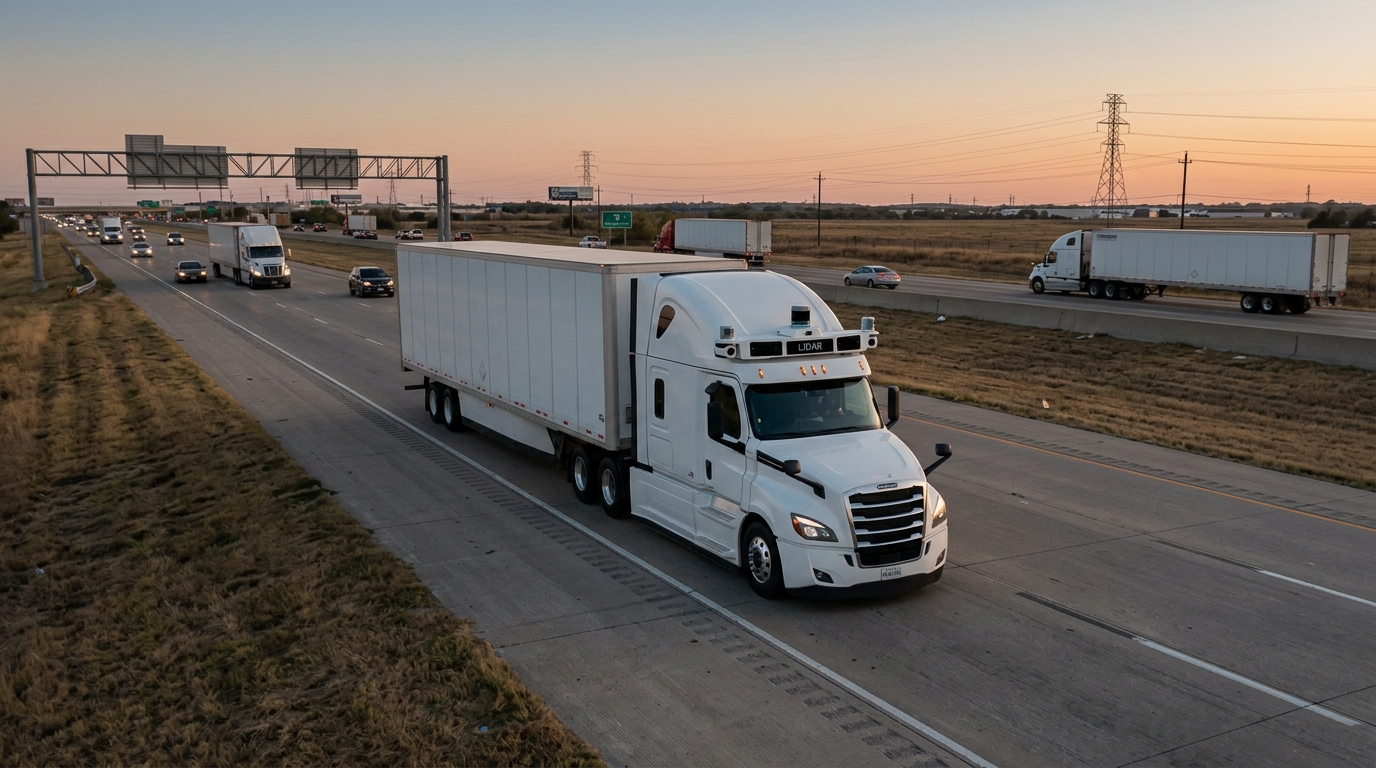
On Interstate 45 between Dallas and Houston, and along I-20 between Fort Worth and El Paso, the freight rate conversation has quietly changed. The question is no longer whether autonomous trucks work. It is whether your competitors are already using them to land lower per-mile costs than you can offer.
Bank of America estimates Aurora’s driverless service runs at roughly $0.85 per mile against approximately $1.30 per mile for human driver wages and benefits alone, before indirect labor is counted. That $0.45 gap is not theoretical. It is running on paying customer freight today, on routes that are publicly mapped and commercially active.
Aurora has logged more than 500,000 driverless miles since its commercial launch and now operates across 10 validated Sun Belt lanes. The Fort Worth to Phoenix corridor, roughly 1,000 miles, completes in approximately 15 hours under autonomous operation. A human driver, bound by federal Hours of Service rules, cannot legally make that run solo. The utilization math alone redraws the economics: Aurora’s trucks are averaging an annualized rate of more than 225,000 miles per year, more than twice the output of a conventionally operated rig.
Berkshire Hathaway’s McLane and carrier Hirschbach are already contracted users. Werner is on the network. These are not innovation partnerships. They are procurement decisions made by freight operators who move perishables and dry goods on tight margin structures and cannot afford to carry a $0.45-per-mile disadvantage indefinitely.
The less-discussed angle is what this means for spot rate exposure during the next freight upcycle. Shippers locked into autonomous vehicle lanes at predictable per-mile rates are structurally insulated from driver-shortage surcharges and carrier pricing power. Those without AV lane access will absorb those costs fully. Kodiak, now operating 35 fully driverless Class 8 trucks in the Permian Basin with its long-haul Autonomy Readiness Measure at 91%, is the second front opening before year-end.
Morgan Stanley’s transportation analyst estimates an autonomous fleet could be about 7.5 times as profitable as a comparable human-driven fleet at current cost structures. That projection carries significant assumptions, but even a fraction of that gap compounding over a 1,000-mile lane changes carrier economics permanently on the corridors where it applies. Goldman Sachs stayed cautious, arguing commercialization will move slower and cost more than optimists expect, which is fair. Aurora’s revenue base is still small, losses are heavy, and the production ramp to 20 trucks per week in Q4 2026 is the real test.
The routes to watch are I-10, I-20, and I-45 through Texas and into Arizona. Freight moving dry van loads between major Sun Belt cities on those corridors is already competing against autonomous capacity. Everything else, weather-variable lanes, complex freight, urban delivery, remains human territory for now. But the dividing line between those two worlds is moving faster than most rate forecasts have priced in.