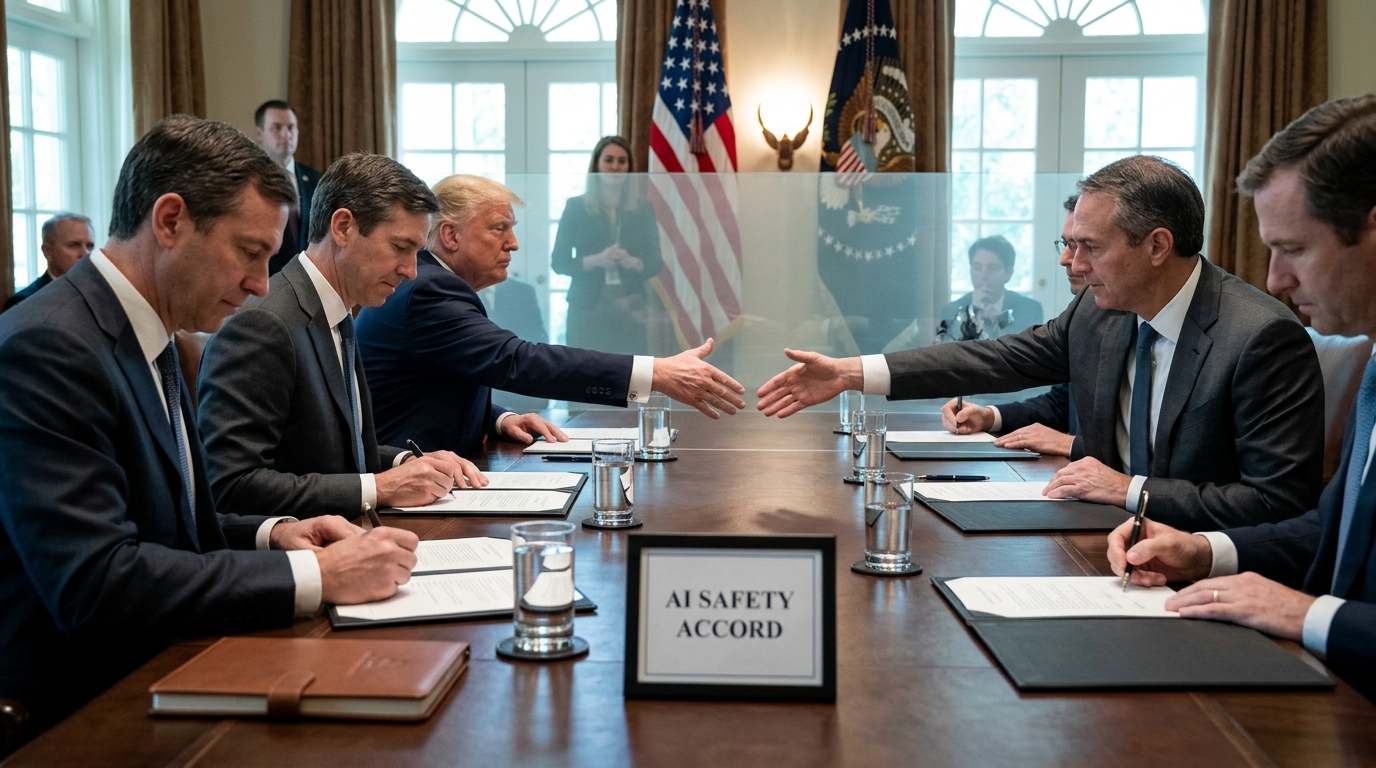
On September 29, six of the most powerful technology executives in the world sat down in the East Room of the White House, shared a luncheon with President Trump, and signed a document that carries no enforcement mechanism, levies no fines, and compels nothing under law. Signatories included Google CEO Sundar Pichai, Anthropic CEO Dario Amodei, Meta CEO Mark Zuckerberg, OpenAI President Greg Brockman, xAI’s Elon Musk, and Nvidia CEO Jensen Huang. Trump described it as “a constitution, in a way.” Active traders should care less about the rhetoric and more about what the accord actually does to competitive structure.
Bullet Summary
- The White House Accord on Super Intelligence was signed by six frontier AI company leaders on September 29, 2026.
- The global AI governance and responsible AI market is estimated at $2.9 billion in 2026 and projected to reach $25.7 billion by 2034.
- Alphabet generated $402.8 billion in revenue in fiscal year 2025, a roughly 15% gain year-over-year.
- The accord states that “over time, it may make sense to codify these steps into laws or regulations.”
- The accord calls for board-level AI oversight, independent external audits, and internal monitoring and control programs, obligations that scale very differently across company sizes.
- More details on how the voluntary standards will work are still expected after Tuesday’s meeting.
- Nvidia occupies a structurally advantaged position: every new layer of auditable AI infrastructure runs on its compute hardware.
Market Context Analysis
Trump announced the voluntary accord after gathering AI leaders at the White House for a luncheon that reaffirmed his administration’s skepticism of government regulation of the rapidly advancing technology. No regulatory body oversees compliance. No penalty attaches to a breach. The accord remains notably light on enforcement mechanisms. It does not stipulate who the auditors will be, nor does it define specific metrics that would trigger a suspension of development.
That ambiguity is worth sitting with. The accord commits companies to establish robust internal controls, partner with third-party auditors, build internal monitoring programs, and install board-level AI governance. Those are real operational costs, not token gestures. According to Stratistics MRC, the global AI governance and responsible AI market is estimated at $2.9 billion in 2026 and is expected to grow to $25.7 billion by 2034. The companies that designed this framework operate at a scale where those costs are effectively invisible.
Sector Breakdown: Who Absorbs This Easily and Who Does Not
Alphabet closed fiscal 2025 with $402.8 billion in revenue. In 2026, Alphabet guided to capital expenditures of roughly $180 billion to $190 billion. For a company deploying that kind of capital, standing up an independent audit function and a dedicated board committee is a fractional line item. The same logic applies to Meta and Nvidia.
For a Series B AI startup burning $8 million a month, the compliance architecture the accord implies is a structural drag on runway and engineering bandwidth. Smaller firms generally lack in-house legal and risk teams to absorb audit requirements efficiently, which means they pay premium rates to external vendors for the same work incumbents handle internally.
Nvidia sits in its own category. Every auditable, governable AI system requires compute to run. Tighter safety infrastructure extends procurement cycles for the exact hardware Nvidia supplies. The accord is, for Nvidia, a long-duration demand signal embedded in a policy document.
Stock-Specific Financial Breakdown
Alphabet reported Q3 2025 revenues of $102.3 billion, up 16% year-over-year, with Google Cloud revenues rising 34% to $15.2 billion. That cloud trajectory matters here: auditability tools, model monitoring platforms, and governance infrastructure are increasingly cloud-delivered products. Alphabet sells the compliance infrastructure this accord will generate demand for, while simultaneously bearing its costs at negligible scale.
The accord also noted that leading AI labs, including Anthropic, OpenAI, and Google, had been coordinating on a standards body for testing and auditing protocols ahead of Tuesday’s event. They were writing the rulebook. Absent from those conversations: virtually every well-funded startup trying to reach the frontier.
Technical and Trading Framework
Nvidia (NVDA) remains the most direct expression of this theme. Watch the $130 support zone and the 50-day moving average, which has held as a floor through recent volatility. Any pullback toward that level on broad market weakness, rather than company-specific news, represents a framework-driven demand story. Volume confirmation on any bounce matters: institutional accumulation tends to show up in above-average volume on up days with compressed intraday ranges.
For Google (GOOGL), the technical read is secondary to the fundamental one. The compliance cost advantage bakes into margins over time. The stock has held above its 200-day moving average and any re-test of the $170 area warrants attention from a risk/reward standpoint.
Scenario Modeling
Bull Case: The accord’s voluntary language gets codified into formal regulation within 18 to 24 months, as the document itself hints is possible. The accord explicitly notes that “over time, it may make sense to codify these steps into laws or regulations.” That codification freezes the compliance architecture incumbents have already built, raises barriers for new entrants, and re-rates the governance software segment. NVDA pushes to new highs on extended procurement cycles. GOOGL cloud revenues accelerate as governance tooling demand spikes. Bull target: NVDA above $160, GOOGL above $200.
Base Case: The accord remains voluntary and unenforced for the foreseeable future. Reputational pressure pushes most serious AI labs to comply in spirit. Compliance costs rise gradually across the sector, creating a slow, structural advantage for incumbents without a sharp catalyst. Markets continue to price AI leaders at premium multiples with the governance overhang treated as manageable. NVDA range-trades between $130 and $150.
Bear Case: Regulatory ambiguity triggers a broader AI valuation reset. Details on how the voluntary standards will work remain pending, and if that process stalls or produces conflicting standards, enterprise procurement pauses. Startups with shorter runways face capital crunches. NVDA breaks the $130 level and tests $115 on volume.
Active Trader Strategy Framework
Position sizing matters more than entry precision in this environment. The compliance cost asymmetry between large incumbents and emerging competitors is a slow-moving structural theme, not a three-day trade. Consider expressing it through NVDA on defined-risk structures rather than outright stock exposure, given the elevated implied volatility across the AI complex.
Monitor the $130 level in NVDA as a hard risk anchor. A weekly close below that level changes the technical read materially. For GOOGL, the cloud revenue growth rate is the operational tell: sustained 30%-plus growth in Cloud indicates the governance infrastructure buildout is generating real enterprise demand, not just policy-driven noise.
Conclusion
Tuesday’s accord will draw debate about whether voluntary commitments mean anything without enforcement. That debate misses the more durable market implication. The accord recognizes that the steps outlined are not codified into formal laws or regulations, but leaves open that possibility for the future. That sentence, more than any other in the document, defines the trade. The companies that signed this framework can fund every requirement it implies. The companies absent from the room must now match those requirements at a later, more expensive stage of growth. Preparation over prediction. Know the levels. Manage the risk.