
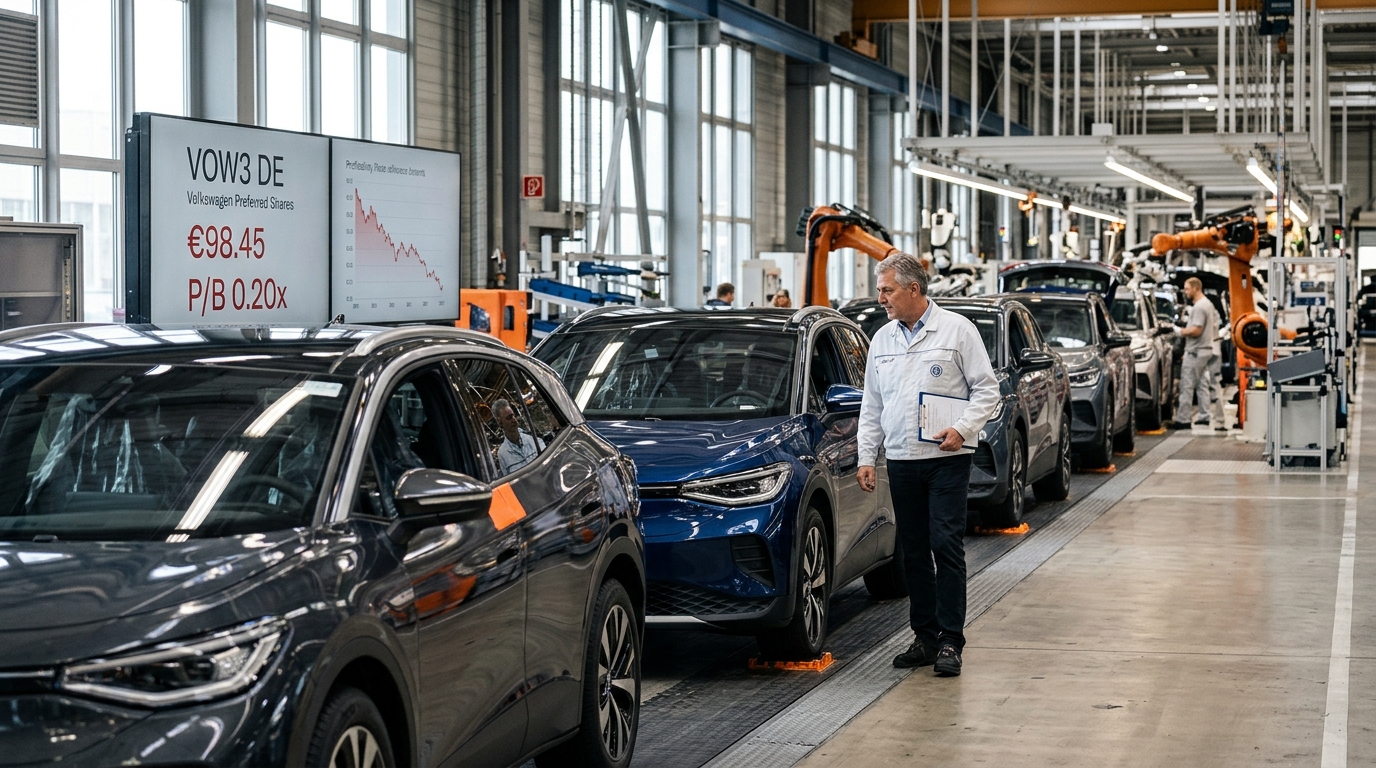
Volkswagen’s preferred shares, VOW3, trade at roughly 0.20 times book value. For context, that means the market is pricing the company at about one-fifth of its net assets. Investors see numbers like that and reach for the word “undervalued.” This week gave a sharper word to reach for instead: unproven.
CEO Oliver Blume told Bild newspaper that Volkswagen aims to sell around nine million vehicles worldwide in 2030 at a nine percent margin, a level the group has never achieved in its history. That is worth sitting with. Not that the target is ambitious. That the gap between where VW stands today and where it needs to go has no historical precedent inside the company itself.
The operating margin was 2.8 percent in 2025. According to Volkswagen’s latest guidance, the group now expects an operating return on sales of up to 1 percent in 2026. So the path runs from roughly 1 percent to 9 percent in four years, through a business cutting more than 100,000 jobs and absorbing billions in severance costs, inside a European auto industry that is structurally losing ground.
What Mercedes Tells You
Mercedes-Benz moved first: the premium automaker halted all investments in its German plants and is exploring site closures to tackle the high cost of car manufacturing in the country. Mercedes decided to suspend investments because it cannot agree with its works council and union representatives on labour cost reductions. According to Mercedes, an hour of labour in German plants can cost up to five times as much as at sites in Eastern Europe.
Mercedes is the control case. It is a premium brand with stronger pricing power than most of the VW portfolio, and even it cannot generate returns that justify continued German capital spending. If the cost structure cannot support a Mercedes investment program, the structural argument for VW’s margin recovery needs more than a CEO’s aspirational number to hold up.
Beyond Germany’s cost problem, Volkswagen faces a difficult development in China. China was the profit engine that funded VW’s global ambitions for a decade. That engine is running cold.
Cheap Versus Value Trap
The distinction matters enormously in practice. A cheap stock has a low price relative to its intrinsic worth: the business earns real returns, the assets are productive, and the market is simply pessimistic. A value trap has a low price because the business cannot earn its cost of capital, and the assets that look valuable on paper are eroding.
VW’s book value per share sits near 350 euros, against a share price around 69 euros. That math screams cheap. But in the third quarter of 2026, Volkswagen reported an operating loss of about 5.9 billion euros, driven largely by one-off items including a writedown tied to its Porsche stake. How VW plans to reach a nine percent margin concretely was not explained in the Blume interview. The 9-point margin expansion over four years is the thesis, and there is currently no roadmap attached to it.
BMW sits in a more defensible position: its price-to-book ratio is roughly double VW’s, which reflects a leaner cost base and a more concentrated brand portfolio. That premium is not irrational.
What Investors Should Watch
The 2030 target becomes investable only when the intermediate steps are visible. Watch the November 24 union negotiations, where Volkswagen starts talks with IG Metall with strikes looming amid tensions over plans that could lead to 100,000 job losses and the closure of up to four German plants. A deal that meaningfully restructures labor costs would be the first concrete evidence the margin math is achievable, not aspirational. Until then, a 0.20x price-to-book ratio is the market’s honest assessment, not an opportunity the market has missed.
Low multiples compress the downside. They do not create the upside. That comes from execution, and execution is exactly what remains unproven.