
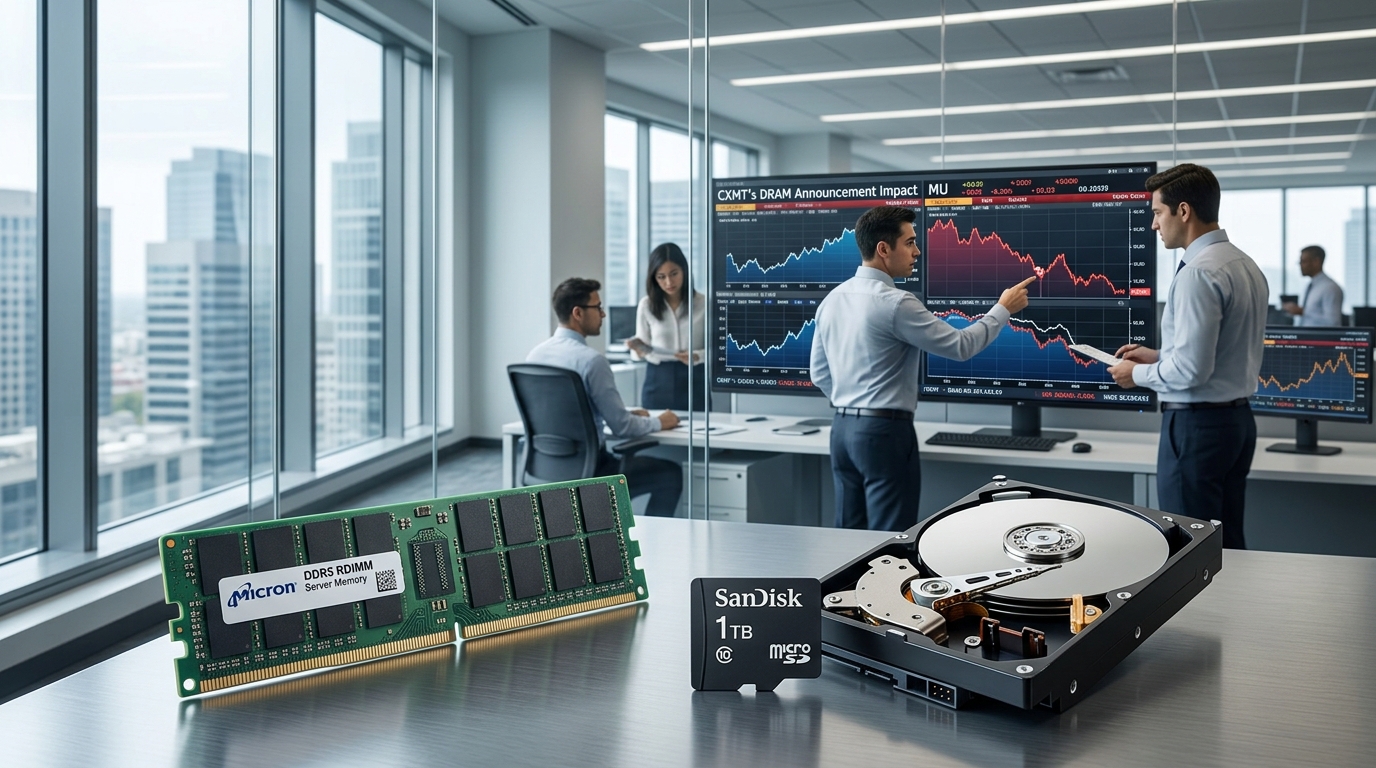
One slide from a conference in Shanghai erased tens of billions of dollars in market value across the global memory complex this week. CXMT President Cao Kanyu introduced the company’s 4F² DRAM architecture at the Oct. 10 Integrated Circuits and Chiplet Conference, with plans to launch next-generation DDR5 RDIMMs based on the technology by year-end.
By Tuesday, the panic had crossed every border: South Korea’s benchmark KOSPI briefly dipped below the psychologically important 6,000 level before recovering, and it finished the session down about 5.5% around 6,035 after heavy foreign selling hit large-cap chip names tied to the AI boom.
That selloff in Seoul made sense. Those companies actually make DRAM. The question worth asking this morning is what happened to the names that don’t.
The Stocks That Got Dragged In
A Chinese memory maker’s breakthrough dragged SanDisk and Seagate sharply lower, even though neither company makes the chip at the center of the storm. SanDisk and Micron were down roughly 2% to 3% in early U.S. trading Tuesday as the global selloff rolled into U.S. hours. Correction: Seagate fell about 4% Monday and closed near $753, not $753.21.
The mechanism was partly mechanical. Because SK hynix, Samsung, and Micron are among the top holdings of the Roundhill Memory ETF, the contagion was immediate, even though SanDisk’s NAND mix and Seagate’s HDD exposure differ from pure DRAM. ETF-driven selling punishes the entire basket, not just the exposed names.
SanDisk: Wrong Product, Real Valuation Problem
SanDisk is a NAND flash maker. CXMT’s 4F² announcement targets server DRAM. CXMT’s announced work targets DRAM, a product SanDisk doesn’t make. On the fundamentals, SanDisk has been telling investors that customer demand is growing faster than its supply, and that it expects bits to remain on allocation beyond calendar 2027. TrendForce also estimates the NAND flash market will record a 4% to 5% supply deficit in 2026, resulting in continued shortages.
So the drawdown looks like a mispricing, in the product sense. The valuation sense is different. Correction: The claim that SanDisk was up 524% year to date could not be verified and has been removed. The broader point stands: when a stock has been a crowded winner, it has the most to give back when sentiment turns. Crowded longs get liquidated on any negative headline touching the sector. That is what happened here. The business case is intact; the position risk is not.
Seagate and Western Digital: A Separate Problem Entirely
Seagate and Western Digital were already wounded before CXMT surfaced. Western Digital and Seagate fell sharply after reports citing Nikkei said Toshiba plans to nearly double production capacity for hard disk drives used in AI data centers within fiscal 2027, and to invest roughly ¥60 billion to expand its Philippine manufacturing footprint, its first major HDD-related capital expenditure in about five years. That signals a direct challenge to the tight supply conditions that have underpinned record pricing power across the industry.
That is a genuine structural threat, not a sentiment trade. Toshiba’s strategic goal is unambiguous: it wants to lift its share of the HDD market by storage capacity from just over 10% toward 30% over the medium term. Bulls argue the math limits the damage: TD Cowen estimated the expansion could add about 75 exabytes against a roughly 300-exabyte supply shortage. Seagate’s HAMR lead and its 44TB Mozaic platform also provide a technology moat that Toshiba’s roadmap won’t close by 2027.
The Cheat Sheet
- Top Market Theme: China’s CXMT claimed a DRAM density breakthrough that markets priced as an immediate competitive reset, even though commercialization at scale remains unconfirmed. Analysts have flagged hurdles including volume production consistency and strict server qualification standards, with the ultimate market impact depending on actual mass-production yields and scale.
- Stock to Watch: Micron (MU). It is the most directly exposed U.S. name to genuine DRAM competition. Correction: The specific market-share figures (CXMT at 9.5% in Q2 2026 vs. 7.6% prior quarter, and Micron at 23.3%) could not be verified from a primary, attributable source in time for publication, so they have been removed. Any yield or shipment data from CXMT’s year-end launch will move MU first.
- Sector to Watch: NAND and HDD storage. The drawdowns in SanDisk and Seagate are two different stories requiring two different recovery triggers. Monitor NAND contract pricing for SNDK and Toshiba supplier capacity announcements for STX.
- Biggest Risk: CXMT demonstrates credible volume shipments of 4F² server DDR5 before year-end. That would compress the timeline markets are currently discounting and force a genuine reset of Micron and SK hynix margins.
- Biggest Opportunity: SanDisk’s NAND business is structurally tight through 2026, and the stock sold off on a DRAM headline. If the AI storage demand cycle holds, the gap between the news and the fundamentals is the entry point.
- One Thing to Remember: Not every stock in the memory complex deserves the same drawdown. Separate the product exposure before drawing any conclusion about which drop is durable.