
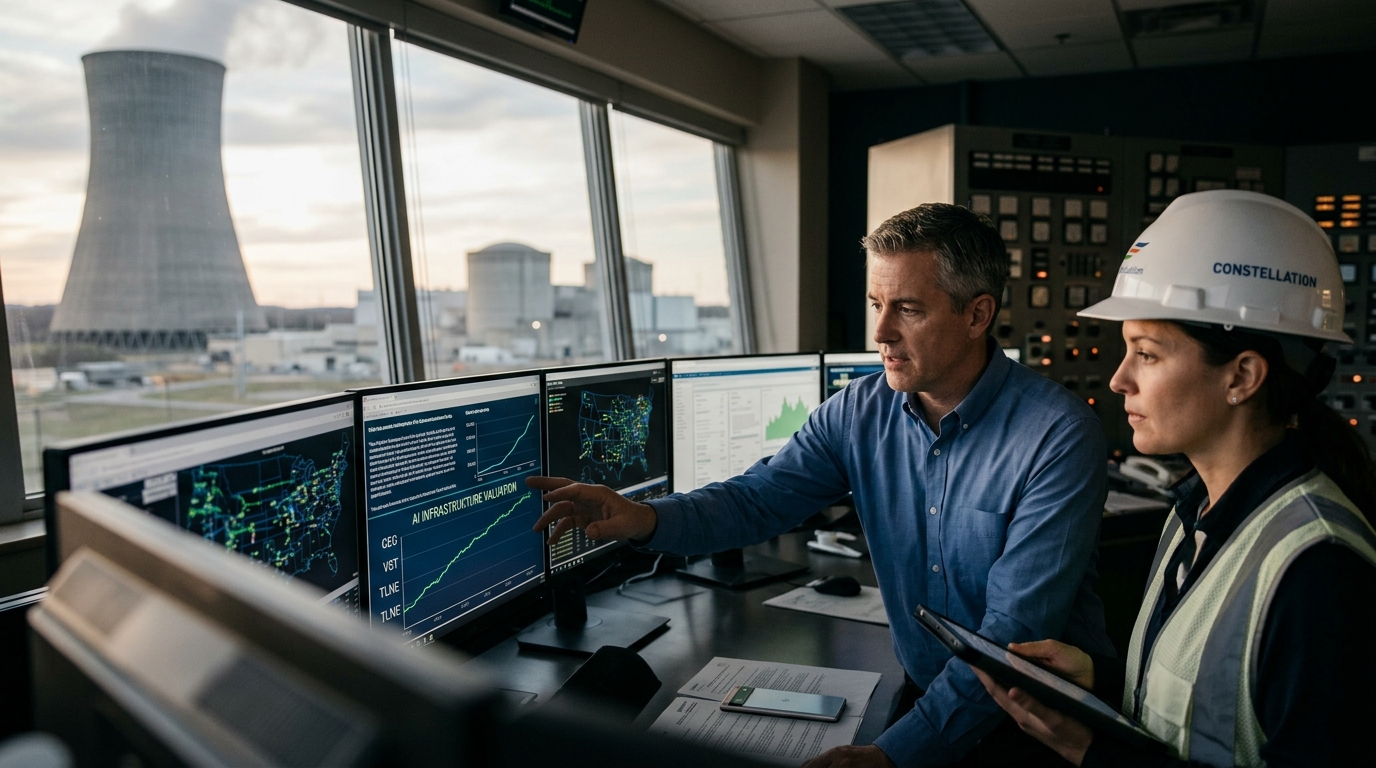
The debate institutional investors have been running all year, whether merchant nuclear names belong in the AI infrastructure bucket or remain glorified bond proxies, effectively ended Tuesday morning. Alphabet’s Google agreed to buy nuclear power from Constellation Energy in a deal that will spur the addition of 890 megawatts of new reactor capacity. The market answered immediately. CEG closed up 32.78 points, or 12.25%, at $300.40 on October 6. Vistra gained 8%. Talen climbed 7%. This was the largest single-day move across the merchant nuclear complex this year.
The structure of the agreement matters as much as the headline number. The 20-year power purchase agreement will drive more than $4.3 billion in investments to upgrade systems at 11 Constellation nuclear units across the PJM market. Alongside that, the companies entered a separate 15-year energy supply agreement covering an additional 2,700 megawatts from Constellation’s existing fleet in PJM. Combined, Google just committed to 3,590 megawatts of contracted supply from a single counterparty. That is not a utility’s yield trade. That is an infrastructure dependency.
Why the Bull Case Hardened Overnight
Nuclear uprates provide a practical, near-term mechanism to deploy firm, clean megawatts, and by modernizing turbines and digital control systems at operating plants, they can deliver meaningful capacity gains without the multi-year timelines or interconnection bottlenecks associated with greenfield construction. Google is not simply buying electrons. It is co-financing a faster path to capacity that no new-build project can replicate.
The upgrades will result in 890 megawatts of new capacity, roughly the output of a new nuclear reactor, delivered to the PJM grid in phases from 2028 through 2032. For Constellation shareholders, that delivery schedule means contracted revenue supports a capital program that was previously hard to finance on speculative power prices alone. The revenue certainty is the investment thesis, not the power price outlook.
The Bear Case Still Has Teeth
The skeptics are not wrong to flag valuation. With CEG around $300, the stock is not cheap, and the margin for error shrinks if the pace or economics of uprates disappoint. CEG’s 52-week high sits at $412.70; its 52-week low at $228.63. Investors buying at $300 after a 12% gap are absorbing a full re-rating in a single session.
There is also a concentration risk that rarely surfaces in the bull framing. Amazon signed a 20-year agreement with Constellation tied to the Calvert Cliffs plant in Maryland that includes 690 megawatts of power, including the 190 megawatt uprate, just last week. Constellation is stacking long-duration contracts with hyperscalers across multiple facilities simultaneously. That is not a diversified power book. It is a concentrated bet that Big Tech demand holds for 15 to 20 years. One hyperscaler capex cycle that cracks could unwind the logic quickly.
What Investors Are Missing: Vistra and Talen Are the Asymmetric Plays
The crowd chased CEG. The smarter conversation is about who benefits from the contract template Google just established without being fully priced for it. Vistra has already signed 20-year PPAs with Meta for about 2,609 megawatts of nuclear power and with Amazon Web Services for 1,200 megawatts, anchoring its generation platform through mid-century. Q2 2026 ongoing operations adjusted EBITDA rose to $1.767 billion, and 2027 adjusted EBITDA midpoint opportunity guidance still excludes any potential impact from the pending Cogentrix acquisition and the Meta deals.
Vistra carries about $19.6 billion in total long-term debt as of June 30, 2026, yet at roughly 15 times forward earnings it trades at a notably lower valuation than Constellation. That gap is the conversation investment committees should be having today, not the 12% CEG move they already missed.
Talen is a smaller operator with about 15.5 gigawatts of generation capacity, anchored by a 90% interest in the Susquehanna Nuclear Power Plant in Pennsylvania. Susquehanna is a two-unit facility with about 2.5 gigawatts gross capacity, or about 2.2 gigawatts net to Talen. Institutional accumulation is visible and still building.
Stocks to Watch
Constellation Energy (CEG) owns the most nuclear capacity of any pure-play US operator and now carries the longest, deepest contracted book. The premium is earned. Whether it is earnable at $300 after a 12% gap-open depends on power price assumptions the market has not yet forced anyone to defend publicly.
Vistra (VST) offers the same AI infrastructure thesis at a lower multiple, with a broader generation mix and an optionality layer through its Helix Digital Infrastructure venture with Nvidia and KKR. Vistra committed up to $1 billion to the Helix fund. The debt load is real, but the earnings trajectory makes it manageable.
Talen Energy (TLN) is the highest-risk name and the most levered to a single asset. Talen operates a 90% interest in the Susquehanna facility, one of the largest nuclear-powered generation facilities in the US, and Susquehanna typically comprises approximately half of Talen’s total annual generation. If the hyperscaler PPA model continues to spread down the counterparty quality curve, Talen re-rates sharply. If it stalls, Talen has limited cushion.