
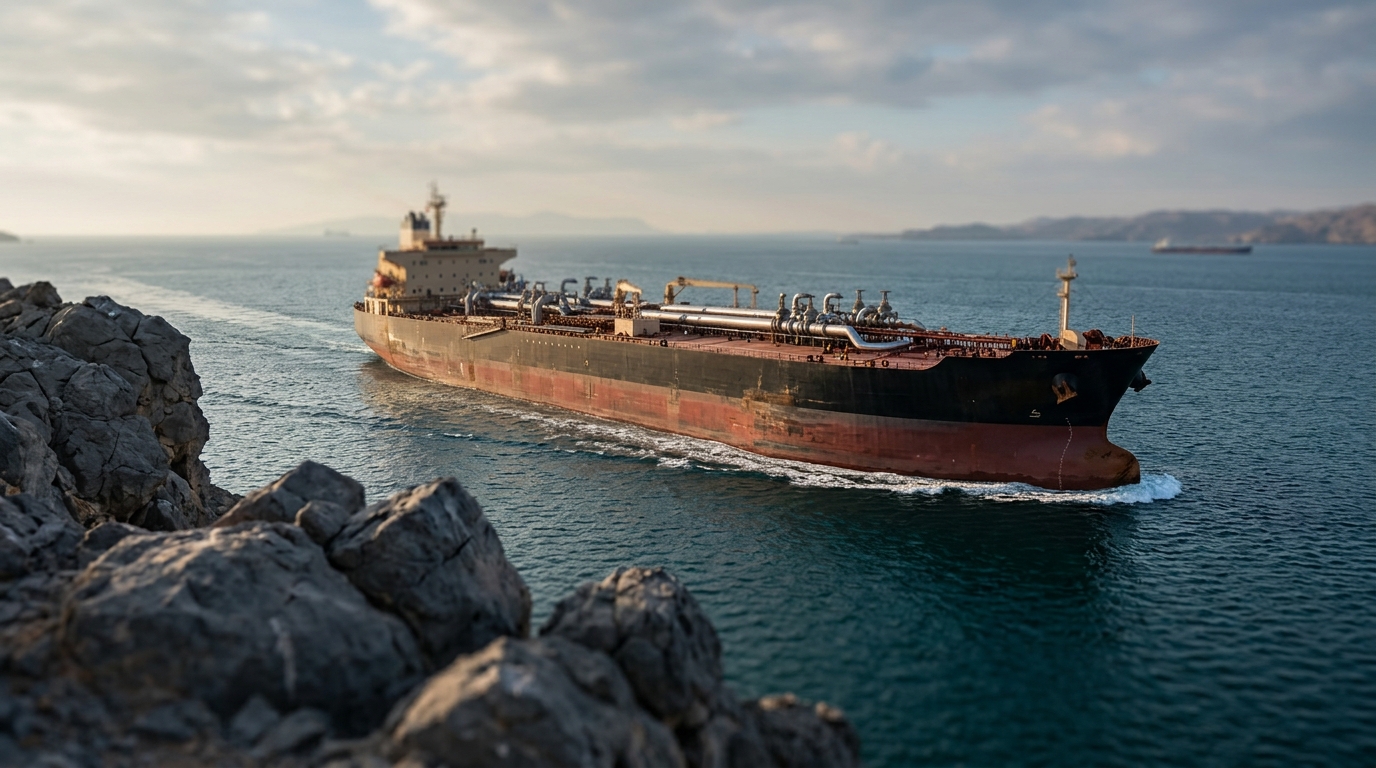
Crude oil’s fifth consecutive losing session is not a random drift. It is the market beginning to price out a specific number: the geopolitical premium that has been embedded in WTI since the Strait of Hormuz was disrupted in late February. That unwinding has a long way to run if diplomacy holds, and the sector rotation it triggers is more interesting than the headline crude move itself.
Iran has offered to open the Strait of Hormuz within seven days if the United States eases its pressure, including taking steps toward ending what Iran describes as a U.S. military blockade of Iranian ports and halting military operations in the Strait, a senior Iranian government official told Japan’s Kyodo News on Tuesday. The proposal carried real weight. Tehran had proposed reopening the strategic waterway within seven days of the blockade being lifted, potentially creating a basis for discussions with mediating countries during the UN General Assembly.
President Donald Trump said Tuesday that U.S. officials had a “very good meeting” with Iran’s delegation and that it lasted about three hours. Trump indicated that his son-in-law Jared Kushner and U.S. special envoy Steve Witkoff met with the Iranians on the sidelines of UNGA. Hours earlier, from the General Assembly podium, Trump told the UN General Assembly a deal with Iran is possible after the midterm elections, but his other choice is to “annihilate the Islamic Republic.” He predicted a deal won’t happen until after November, saying, “I believe we’ll make a deal right after the election because it doesn’t make sense for them not to.”
The market read the meeting as more important than the speech. WTI futures for November fell 1.26% to $89.36 per barrel on Wednesday morning. That follows Tuesday’s $90.52 close, itself down $1.85 on the session. Oil fell further amid optimism that supply disruptions would ease, with Brent crude for November delivery dropping 0.71% to $98.55 a barrel.
Supply signals from Iran itself are adding to the pressure. Iran has restored about 50% of damaged production capacity at the South Pars gas field, according to Deputy Oil Minister Ahmad Zeraatkar, as reported by the semi-official Fars news agency. In late August, the minister had said about 40% of the damaged capacity had been returned to production. The pace of restoration is accelerating ahead of winter. Meanwhile, Saudi Arabia began preparations to restart its East-West oil pipeline, which was halted after drone attacks earlier this month, with exports potentially resuming later this week.
So how far does WTI fall if Hormuz actually reopens? Oil prices surged roughly 50% since the Iran war began, as the conflict disrupted Hormuz and sharply curtailed Middle Eastern oil production. The 52-week price range for WTI futures spans from $54.98 to $117.63. A full resolution does not take crude back to $55 overnight, but the structural premium embedded above $80 is vulnerable fast. The pace matters more than the destination.
That pace also matters for Treasury yields. The 10-year Treasury yield fell nearly 2 basis points to 4.93% on Tuesday, reversing a modest early-session rise, as oil prices declined for a fifth straight session. Renewed hopes for a diplomatic solution pushed oil down and helped ease concerns over inflationary pressures. Cheaper crude directly compresses the inflation component of long yields. If WTI breaks convincingly below $85, the 10-year has room to retrace toward 4.6% to 4.7%, which would broaden equity appetite beyond the defensive energy names that have outperformed all year.
Airlines are the most direct expression of this thesis. American Airlines said the increase in fourth-quarter fuel prices was adding roughly $1 billion to its expected costs compared with assumptions made in July. A $15 to $20 sustained move lower in WTI changes that math materially. AAL, UAL, and DAL each rose more than 2% on Monday as crude slid, with Southwest advancing 1.7%. That was a one-day response to diplomacy headlines. A confirmed reopening of Hormuz would be a multi-week reshuffling of the sector’s forward cost structure.
The risk is that this deal follows the same pattern as the June memorandum of understanding. The U.S. and Iran signed a memorandum of understanding in June aimed at opening Hormuz to commercial shipping, but the arrangement quickly unraveled as fighting resumed and both sides disputed operating conditions in the Strait. Trump himself frames November midterms as the likely timeline for any durable agreement. That gap is the trade’s principal risk.
The highest-conviction setup right now is not a straight short on crude or a blind buy on airlines. It is a relative trade: long the carriers most leveraged to jet fuel cost relief (AAL, DAL), hedged against energy producers (XOM, CVX, OXY) that are pricing a soft landing in oil but still vulnerable to a sharper drop on a confirmed Hormuz opening. Monitor whether Trump’s UNGA comments about November translate into a structured negotiating timeline. If a formal framework emerges before the end of the week, the war premium exits faster than the market is currently positioned for.