
The FDA approval that landed on Friday was AstraZeneca’s headline. The more durable beneficiary may be Guardant Health.
Why This Stock Now
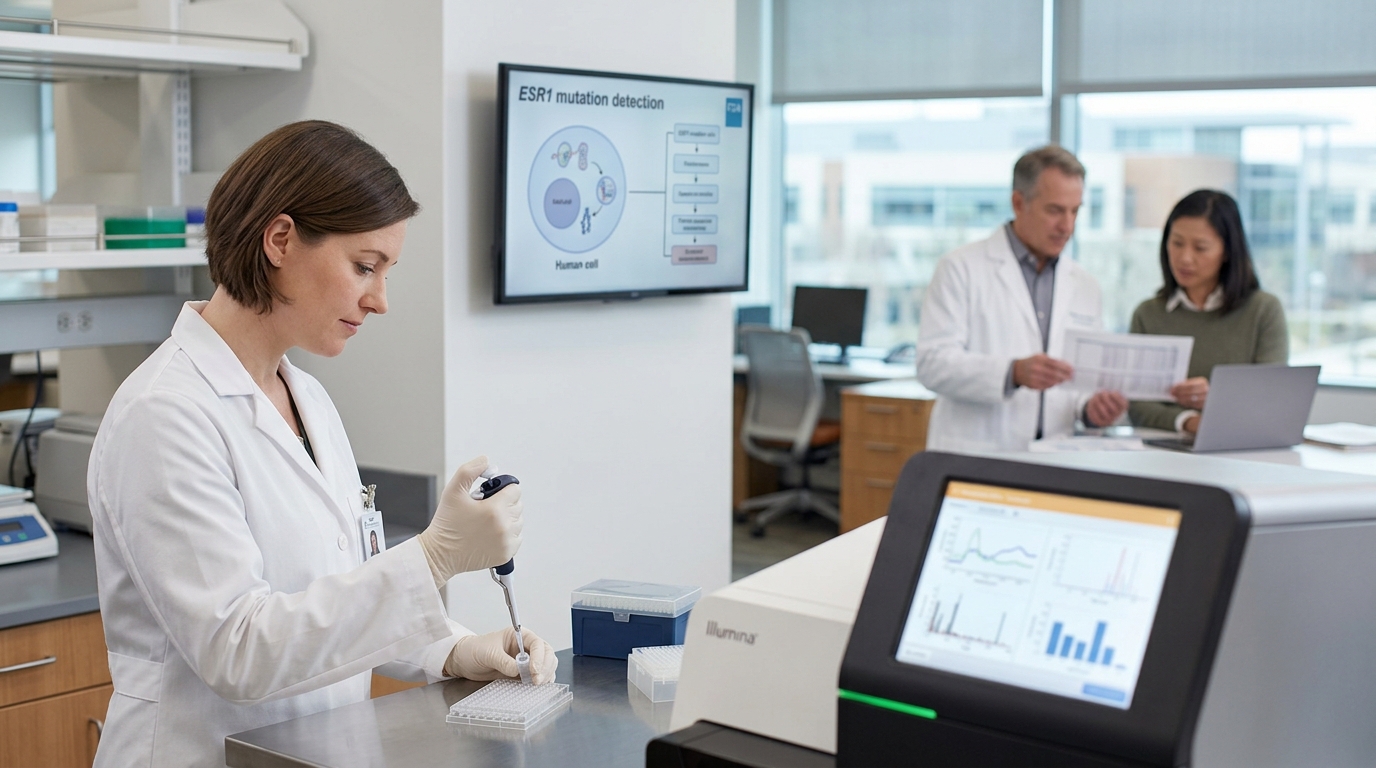
The FDA granted accelerated approval to camizestrant (ETCAMAH) in combination with a CDK4/6 inhibitor for adults with HR-positive, HER2-negative locally advanced or metastatic breast cancer upon detection of an ESR1 mutation during aromatase inhibitor and CDK4/6 inhibitor therapy, based on an FDA-authorized test. What the AstraZeneca headlines have largely underplayed: the FDA simultaneously approved the Guardant360 CDx assay as the companion diagnostic to identify eligible patients via circulating tumor DNA testing. In practice, that makes testing a required step for on-label use.
The Business
Guardant Health develops blood tests that detect and monitor cancer by analyzing tumor DNA in the bloodstream, helping doctors make treatment decisions without invasive biopsies. The Guardant360 CDx is already the workhorse of that franchise. The largest FDA-approved liquid biopsy, Guardant360 Liquid CDx integrates genomic and epigenomic data and holds approved companion diagnostic indications across multiple cancers, including breast cancer ESR1 mutation testing tied to endocrine therapy selection. Friday’s camizestrant label adds another mandatory referral channel to that category.
Why Wall Street Is Paying Attention
This is the first FDA approval of a cancer therapy guided by ctDNA resistance mutation detection before standard imaging demonstrates disease progression. That regulatory precedent matters well beyond AstraZeneca. Every oncologist now has a blueprint, and a label obligation, to order serial blood-based ESR1 testing in first-line HR-positive metastatic breast cancer patients. In practice, published clinical discussions around this setting commonly cite ESR1 mutation rates around 30% to 40% after first-line endocrine therapy with a CDK4/6 inhibitor, meaning the eligible testing pool is large and the test is not a one-time order but a longitudinal monitoring protocol.
Guardant’s underlying financials were already moving before Friday. Second quarter 2026 revenue reached $335 million, a 44% year-over-year increase, with oncology revenue up 38% to $219.1 million on approximately 104,000 oncology tests, a 63% volume increase. The company subsequently raised its full-year 2026 revenue guidance to $1.34 billion to $1.36 billion, representing 36% to 38% growth. The camizestrant label was not reflected in those July 30, 2026 figures.
What’s Driving the Opportunity
The pivotal SERENA-6 data showed that switching to camizestrant upon detection of emergent ESR1 mutations improved progression-free survival by a median of 7.6 months compared with continuing the same aromatase inhibitor-based regimen. That outcome strengthens the oncologist’s clinical rationale for monitoring, not just testing at a single point in time. The label’s logic demands repeated blood draws and repeated Guardant tests.
The Guardant360 test is broadly covered by Medicare and many private payers, representing over 300 million covered lives, so reimbursement friction is not a bottleneck to adoption at scale. Analysts hold a consensus moderate buy rating on Guardant, with an average price target implying roughly 25% upside from late-July levels. That target was set before camizestrant’s approval crossed the finish line.
What Could Go Wrong
Guardant is not yet profitable. The company reported a net loss of $120.1 million in the second quarter alone. The companion diagnostic revenue per approval, while reliable, is not transformative on its own. The camizestrant approval is accelerated, meaning AstraZeneca will still need to confirm clinical benefit in a post-marketing trial, and a failure there could unwind the indication. Competing liquid biopsy developers and tissue-based ESR1 assays remain in the market. Guardant holds the label designation today, but the competitive perimeter requires watching.
The Bottom Line
The FDA just did something it has never done before: approved a cancer drug whose trigger is a blood test result rather than a radiographic image. Guardant Health owns the FDA-approved liquid biopsy companion diagnostic used for that trigger in camizestrant’s label. With volume already accelerating at 63% year-over-year in oncology tests and full-year guidance raised on July 30, 2026, the business had momentum before Friday. The camizestrant label adds a durable, label-mandated demand source to a test that oncologists were already ordering. That is a concrete, near-term catalyst on top of a growth story that was already working.