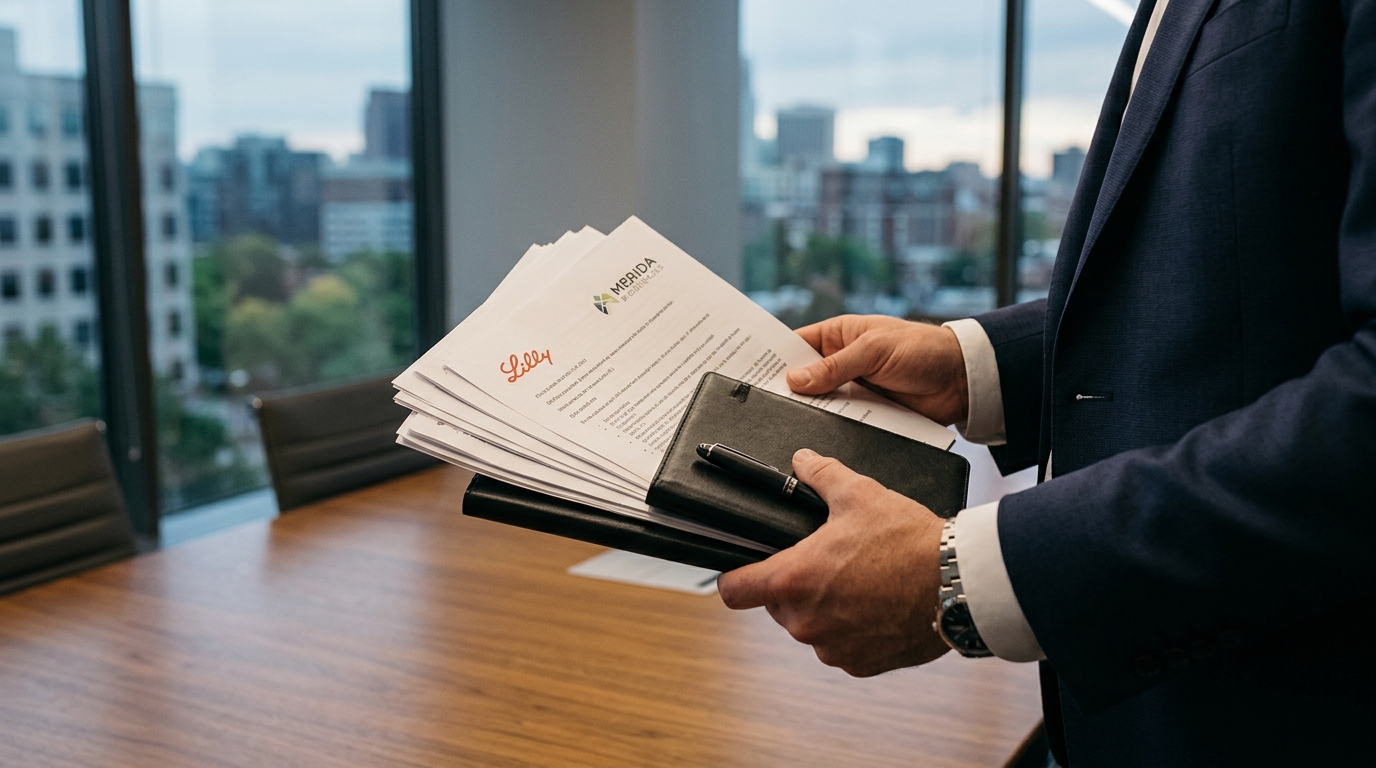
Eli Lilly dropped another nearly $3 billion on Monday. The company agreed to acquire Merida Biosciences for up to $2.875 billion in cash, adding a biotechnology platform designed to eliminate the antibodies that cause autoimmune and allergic diseases. The market’s reaction: LLY fell roughly 1.5% on the session. That is the real story.
The Business
Cambridge, Massachusetts-based Merida is developing biologics engineered to target and degrade disease-causing antibodies without broadly suppressing the immune system, an approach the company says differs from many existing therapies. Its lead drug candidate, MER511, is in Phase 1 development for Graves’ disease and thyroid eye disease, two conditions driven by autoantibodies that activate the thyroid-stimulating hormone receptor. The acquisition also brings MER769, a preclinical program aimed at antibody-driven allergic conditions, along with earlier research programs targeting immune-related kidney diseases.
Lilly’s growth is heavily concentrated in weight-loss and diabetes medicines. Autoimmune and allergic diseases offer large chronic patient populations, long treatment durations, and established reimbursement, giving Lilly a potential second commercial pillar that reduces dependence on a single therapeutic class. The logic is sound in theory. The execution timeline is the problem.
Why Wall Street Is Paying Attention
Lilly has embarked on an aggressive merger and acquisition spree in 2026, acquiring and partnering with biotech companies across oncology, neuroscience, cardiovascular disease, gene editing, and vaccines to diversify its long-term growth drivers beyond GLP-1 therapies. The company has announced more than $20 billion in biotech deals this year. Merida is the latest in a string that includes AtaiBeckley, a psychedelic medicine developer acquired in July for about $2.8 billion upfront, with another $1 billion possible through milestones.
The GLP-1 franchise is funding all of it. For the first half of 2026, Mounjaro generated sales of $18.605 billion, up 106% from the first half of 2025. Zepbound generated $9.088 billion in the same period, up 60% year over year. And just last Thursday, the FDA approved Mounjaro to reduce cardiovascular risk in adults with type 2 diabetes at high risk for these events, making it the first and only dual GIP and GLP-1 receptor agonist proven to lower the risk of heart attack, stroke, or cardiovascular death in that population.
What’s Driving the Opportunity
Lilly posted Q2 revenue of $23.0 billion, up 48% year over year, and raised its full-year revenue guidance to a range of $85 billion to $87 billion. The Mounjaro cardiovascular label expansion matters commercially: insurance companies may now cover the drug for that new cardiovascular-risk indication, potentially pulling in patients who were previously excluded on coverage grounds.
Analyst sentiment remains constructive. Cantor Fitzgerald raised its price target on LLY from $1,350 to $1,410 and maintained an overweight rating in early August. As of September 1, 2026, the exact number of analysts with a Buy consensus rating varies by data provider and updates daily.
What Could Go Wrong
The most immediate risk sits outside Lilly’s control. Some recent employer surveys and reporting indicate employers are pulling back on coverage for GLP-1 weight-loss drugs, largely due to cost. A Mercer survey found that among employers with 500 or more employees, 6% dropped coverage for GLP-1 weight-loss drugs in 2026, and another 5% are planning or considering dropping it for 2027. Separately, the Business Group on Health reported that 10% of companies currently covering GLP-1s for weight management say they are unlikely to continue in 2027 for cost reasons. However, the specific claim that employer coverage fell from 72% in 2025 to 60% in 2026 depends on how the survey defines its population and question and cannot be treated as a universal market statistic without that context.
On the acquisition side, MER511 remains an early-stage asset and the acquisition requires a sizable cash commitment before commercial benefits are established. Merida only exited stealth last year. Paying nearly $3 billion for a Phase 1 asset is a bet on science that has years of development ahead, regardless of how elegant the mechanism looks on paper.
The Bottom Line
Lilly is a genuinely exceptional business. The Q2 numbers, the Mounjaro cardiovascular approval, and the breadth of its pipeline all support a long-term bull case. But Monday’s price action reflects a real tension: management keeps deploying billions into early-stage assets while the employer coverage data suggests the private-pay side of the GLP-1 market may tighten faster than expected. That is not a rounding error. It is a structural question about who pays for the drugs that underwrite everything else.
For investors willing to hold through years of clinical development on the new assets while monitoring GLP-1 demand, LLY near current levels offers reasonable risk-adjusted potential. For those hoping the acquisition pace alone justifies the premium, Monday’s reaction was a useful reminder that the market wants results, not just receipts.