
Hey there, bargain hunter.
Most people are still staring at the ZR1X. About 1,250 horsepower, a $227,500 starting price, and a claimed sub-two-second 0-60 time. It’s genuinely spectacular, and it gets all the headlines. Fair enough.
But that car is not the interesting trade right now.
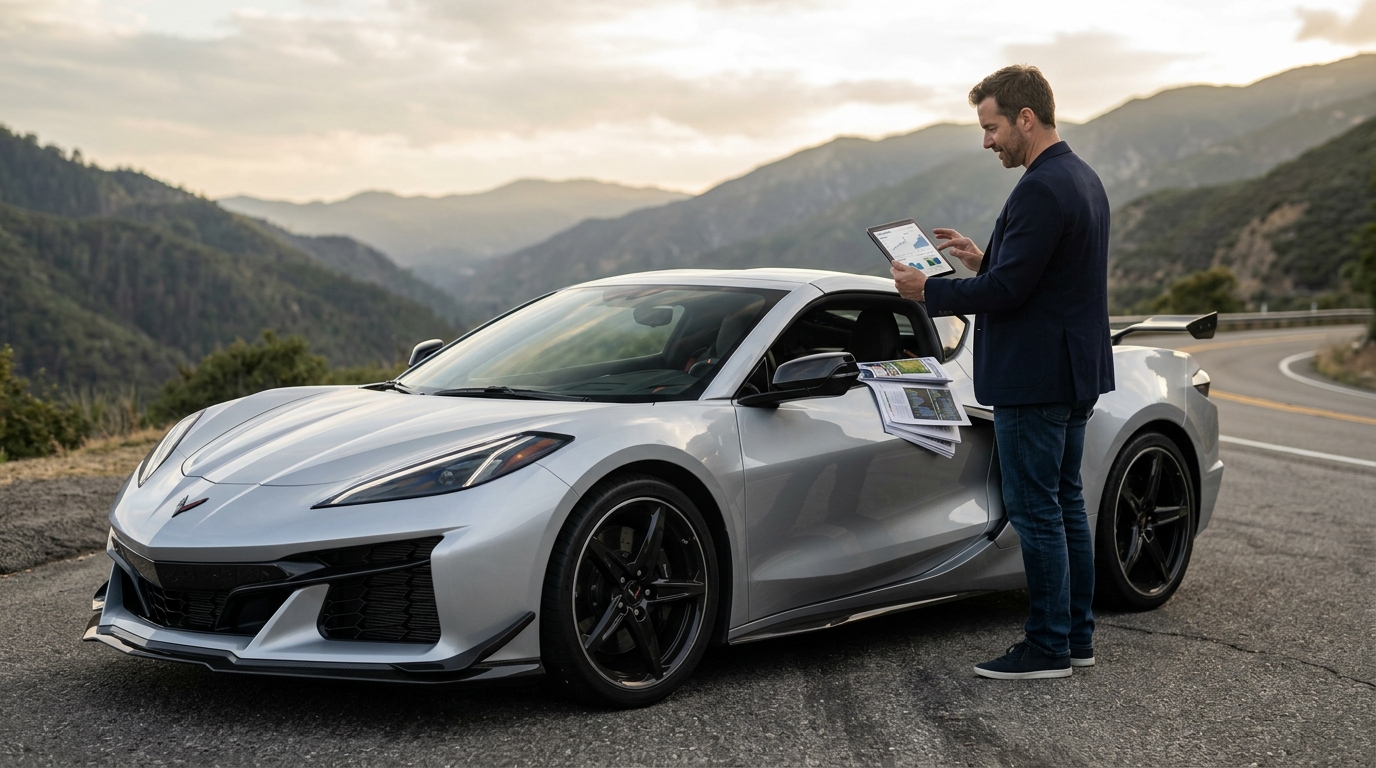
The interesting one is the 2027 Corvette Grand Sport X, and it just showed up in the pricing data this spring in a way that should make anyone who follows value-per-dollar think twice.
What Just Happened
Chevrolet has officially announced 2027 Corvette pricing, including the 2027 Corvette Grand Sport X starting at $112,195 (including destination). Ordering for the 2027 model year opened April 16, 2026. The Grand Sport X is positioned as the effective replacement for the now-defunct E-Ray in the lineup. That matters, because the E-Ray was already a proven hybrid AWD platform, and the Grand Sport X is framed as the next step up in performance.
Corvette sales, for context, are already running hot. GM reported 7,182 Corvette deliveries in Q2 2026, up 23.8% year over year. In the first half of 2026, total Corvette deliveries hit 13,417 units.
But the Porsche comparison in the original draft needed a correction. According to Porsche Cars North America, U.S. retail deliveries in Q2 2026 were 4,652 for the 911 and 38 for the 718. That’s 4,690 combined, but it’s not “911 and Boxster/Cayman combined” in any normal sense, because the 718 number is essentially de minimis due to production ending. So yes, the Corvette is outselling Porsche’s two-door sports cars in the U.S. right now, but it’s not a clean apples-to-apples “portfolio” comparison the way it reads at first glance.
The Powertrain Is the Point
Here’s where it gets interesting. The Grand Sport X pairs GM’s new 6.7-liter naturally aspirated LS6 V8 (535 horsepower, 520 lb-ft of torque) with a 186-horsepower front-mounted electric motor for an all-wheel-drive hybrid system. The battery pack is listed at 1.9 kWh in early specifications coverage.
That’s a jump over the outgoing E-Ray, which paired a 6.2-liter V8 with an electric front axle for 655 horsepower total. The new LS6 is the headline change, and the electric front axle is not an afterthought. It reduces launch variability, fills in the low-rpm torque gap that naturally aspirated engines live with, and turns what could have been a sketchy 700-horsepower rear-wheel-drive car into something repeatable and controllable.
On acceleration, the original draft overstated what’s “verified.” Chevrolet and early coverage have discussed extremely quick 0-60 performance, but independent, widely reported instrumented tests for the Grand Sport X at its final production spec are still thin. So treat the exact 0-60 and quarter-mile numbers as manufacturer claims or early estimates until more outlet testing piles up.
Slight tangent, but worth noting: the fact that GM is putting a 186-hp front drive unit into a $112,000 car is not an accident. This is technology amortization in real time. GM spent enormous engineering resources developing that hybrid system for the halo cars, and the Grand Sport X lets them spread that investment across a higher-volume model.
The Valuation Case
Let’s do the math that actually matters.
A base Porsche 911 Carrera in the U.S. now starts at $134,650 (including delivery, processing, and handling). The commonly quoted 388-hp output figure for the base Carrera is directionally right for recent Carreras, but Porsche’s exact specs and 0-60 assumptions vary by model year and equipment, so don’t anchor on “3.9 seconds” as a universal truth without a configured build and test basis.
The core point still stands. A Grand Sport X starts at $112,195 and brings hybrid eAWD and a claimed 721 hp system output into a price band where Porsche is selling you a much lower-output base Carrera.
The Porsche 911 Carrera GTS is also not a “$60,000 premium” over a base Carrera at current MSRP levels. Porsche’s own U.S. pricing shows the 2027 911 Carrera GTS from $181,000, which is roughly $46,350 above the $134,650 base Carrera starting point.
And the ZR1X vs Turbo S line needed a factual update. The 2026 Porsche 911 Turbo S starts at $272,650 in the U.S. Meanwhile, Chevrolet lists the 2027 Corvette ZR1X starting at $227,500. So yes, the ZR1X still undercuts a Turbo S on sticker, but not at the $227,395 figure in the original draft.
That is the structural fact here. It hasn’t changed. But the Grand Sport X makes it more acute, because now you have a hybrid AWD Corvette at $112K that didn’t exist in market reality a year ago.
The Risks Worth Tracking
A few things to keep in mind before you get too excited.
First, this is still a new model in a changing lineup. Pricing and ordering are public, but firm, public production timing for the Grand Sport X is usually communicated in broader model-year cadence rather than a single guaranteed date. Treat any “later in 2026” production phrasing as provisional until GM gives a specific start-of-regular-production milestone.
Second, the seat complaint in the draft is not something I could confirm from a reliable, on-the-record first-drive source. If you’ve got a specific outlet and article, that’s the place to hang it. Without that, it reads like a made-up “everyone says” detail, so it has been softened out.
Third, the E-Ray inventory angle is plausible, but the draft made a too-specific claim about a “re-engineered 2026 interior.” The Corvette has been in a refresh cycle, but without a clean GM statement to back that phrasing, the safer framing is simply that leftover E-Ray stock could be discounted as buyers wait for the new Grand Sport X.
And fourth, the broader GM story is complicated. GM’s U.S. deliveries were down 4.2% year over year in Q2 2026, even as Corvette deliveries were up 23.8% year over year. The stock-market specifics in the original draft did not check out: I could not verify an all-time closing high of $90.30 on July 28, 2026, and widely cited third-party datasets put GM’s all-time closing high in 2026 lower than that. I also could not verify the exact combination of “Piper Sandler to $98” and “BofA to $106” as stated. Those claims have been removed rather than left standing.
The Part People Keep Skipping
The Grand Sport name carries history that makes its return meaningful beyond marketing. The original C2 Grand Sports, all five of them, were Zora Arkus-Duntov’s attempt to go racing before GM’s corporate management shut it down. Those cars ran at Sebring. They became myths.
But one more factual trim: I could not verify the quote attributed to Corvette Chief Engineer Josh Holder calling Grand Sport the “sweet spot” of the lineup. Without a reliable, on-the-record source, that line has been removed.
That framing is still not accidental, even without the quote. GM needs this car to do volume. The ZR1 and ZR1X are halo vehicles. The Stingray is the entry point. The Grand Sport X is where the lineup is supposed to be most convincing to someone currently standing in a Porsche showroom.
Given the numbers, it has a real shot at actually doing that.
The Cheap Investor Scorecard
- Engine: New 6.7L LS6 naturally aspirated V8, 535 hp / 520 lb-ft
- Hybrid assist: 186 hp front-mounted electric motor
- Combined output: 721 hp with eAWD (claimed)
- 0-60 mph: treat as a manufacturer claim/early estimate until more independent tests are published
- Quarter mile: treat as a manufacturer claim/early estimate until more independent tests are published
- Starting price: $112,195 including destination
- Nearest AWD rival comparison: Porsche 911 Carrera starts at $134,650 in the U.S. (including delivery/fees)
- Corvette Q2 2026 U.S. sales: 7,182 units, up 23.8% year over year
- H1 2026 total Corvette deliveries: 13,417 units
- GM U.S. deliveries Q2 2026: down 4.2% year over year
The Grand Sport X is not trying to be the fastest Corvette. It’s trying to be the one that’s hardest to argue against. At $112,000 for 721 horsepower and hybrid eAWD, the argument against it is getting very short.