
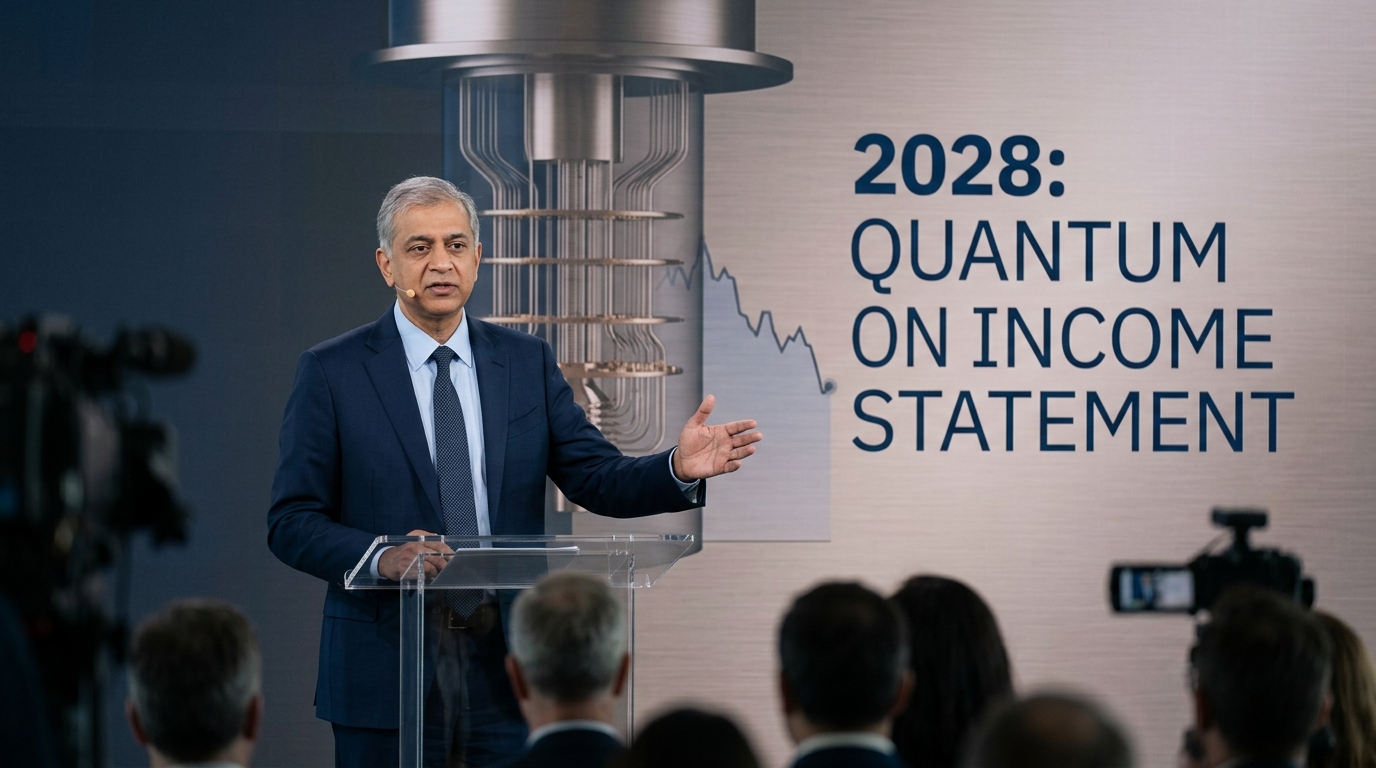
Here is the tension in one sentence: IBM just suffered the worst single-day stock decline in its history, and then its CEO went on national television days later and told investors quantum computing will hit the income statement by 2028 or 2029.
That is not a contradiction. That is a signal.
The question worth sitting with is whether the market is pricing a legitimate execution failure or something more durable. Because what happened on July 14, 2026 was violent, and what happened on July 30 was quietly extraordinary. Both things are true. They just point in very different directions.
What the Stock Got Wrong About July 14
The numbers from IBM Q2 were not good. Revenue came in at $17.2 billion, up just 1% year over year, roughly $660 million below the LSEG consensus of $17.86 billion. Operating (non-GAAP) EPS came in at $2.93, also below estimates. IBM stock dropped 25.21% in a single session, erasing roughly $68 billion to $69 billion in market value. It was the worst single-day percentage drop since at least October 1987.
CEO Arvind Krishna did not sugarcoat it. In his investor letter he said the company had faltered. That phrasing mattered. It was direct, which is rare, and it focused the conversation on execution rather than structural deterioration. He cited weaker Z mainframe performance and a pullback in transaction processing software as customers redirected spending toward servers, storage, and memory purchases ahead of expected price increases. Consulting revenue came in essentially flat.
The part the headline numbers missed: IBM said about 40% of the delayed deals had closed by the time of the July 14 investor letter. That detail matters. A postponed deal is different from a lost one. The market, rattled by a pre-announcement that landed alongside June CPI data and major bank earnings reports on one of the busiest mornings of the season, did not have time to make that distinction.
When full Q2 results came out on July 22, software showed 5% growth, infrastructure revenue fell 7% to $3.84 billion, and IBM Z revenue fell 42% year over year. IBM lowered its full-year constant currency growth guidance to 4% to 5%, down from the prior target of over 5%. The company kept its expectation for about $1 billion in incremental free cash flow for 2026.
Generative AI crossed a $7.5 billion book of business. That number did not get nearly enough attention.
And Then July 30 Happened
Sitting down with CNBC, IBM CEO Arvind Krishna said something that should stop any serious investor cold: quantum computing will have a measurable impact on IBM’s top and bottom line by 2028 or 2029. Then he went further. By the end of the 2030s, he said, the company is pretty convinced this is a trillion dollars of value.
These are not moonshot talking points. This is a CEO speaking in years and dollars. That is a different category of commitment.
IBM is on track to deliver its first large-scale, fault-tolerant quantum computer in 2029. The company has said it is committing more than $10 billion to quantum over the next five years, spanning R&D, capital expenditures, manufacturing, acquisitions, and ecosystem expansion. IBM has also said it expects partners using IBM quantum computers to demonstrate quantum advantage in 2026.
The part people are skipping: he said this weeks after his company’s worst stock day in history. That is not a CEO playing defense. That is a CEO making a specific forward commitment because he believes the underlying roadmap is intact.
Anderon Changes the Physics of the Trade
In May 2026, IBM and the U.S. Department of Commerce announced a letter of intent to build Anderon, America’s first purpose-built quantum chip foundry. The deal is backed by a proposed $1 billion in CHIPS incentives from the Department of Commerce, matched dollar-for-dollar by IBM in cash, along with intellectual property, manufacturing assets, and workforce. Total cash funding proposed at launch: $2 billion, with additional investors expected as Anderon grows.
Anderon is expected to be based in Albany, New York as a standalone IBM company, operating a 300-millimeter quantum wafer foundry designed to support a broader quantum ecosystem, not only IBM. That last piece is important. If Anderon succeeds, it becomes infrastructure for the quantum sector, not a captive IBM division.
The industry context matters. MarketsandMarkets projects the quantum computing market growing from roughly $3.5 billion in 2025 to over $20 billion by 2030. IBM has cited projections that quantum computing could create up to $850 billion of economic value by 2040.
The Competitive Map
IBM’s rivals in quantum are real, and they deserve honest treatment.
Alphabet, IonQ, and Rigetti are all racing toward commercialization. IonQ has disclosed the sale of its first chip-based, 256-qubit system in 2026. Rigetti uses a modular architecture available through cloud providers. Microsoft is taking a different architectural path entirely, betting on topological qubits through its Majorana 1 processor, arguing that error reduction matters more than qubit count in the race to commercial viability.
What IBM has that none of these competitors can replicate quickly: manufacturing infrastructure, a more-than-$10 billion committed investment, a government-backed foundry plan, enterprise relationships across the Fortune 500, and a CEO willing to put specific earnings-impact years on the record publicly. That combination distinguishes IBM from every other player in the space.
The pure-play quantum stocks, IonQ and Rigetti in particular, trade on speculation about future advantage. IBM trades on an existing, cash-generating business with quantum as an embedded option. Those are fundamentally different risk profiles for different types of investors.
The Stock’s Current Position
IBM was down roughly the mid-20% range year to date as of late July 2026, while the S&P 500 was up roughly the high-single-digit range over the same period. IBM hit a 52-week high of $332.46 on June 2, 2026. It then fell into the July 14 pre-announcement, which knocked the stock into the low-$200s.
Street consensus sits roughly in the $288 to $305 range. Wedbush is more constructive, arguing the stock reaches $350 even without quantum contributing commercially, with a bull case near $449 if quantum begins hitting earnings on Krishna’s 2028 to 2029 timeline. HSBC sits on the more skeptical end, flagging consulting recovery risk. The spread between those two camps is wide. That spread is the trade.
One additional overhang: multiple plaintiff-side law firms have announced investigations into potential securities law claims tied to the July 14 drop and IBM’s disclosures about deal timing and pipeline strength. That is unresolved and cannot be dismissed.
Technical Structure
IBM is attempting to build a base after the historic July 14 selloff. The bounce from the low-$200s area to the mid-$220s represents early stabilization, but the stock remains well below its 50-day and 200-day moving averages. The low-$200s area functions as critical near-term support. A sustained break below that level reopens a test of the high-$190s.
Volume on the recovery bounces has been below the volume on the breakdown sessions, which is typical post-crash behavior but not yet confirming institutional re-accumulation. Watch for any close above $240 on above-average volume as the first meaningful signal that the base is holding. The 50-day exponential moving average in the $240 to $250 range becomes the first real resistance level to reclaim before any discussion of the gap back toward $280 makes sense.
Implied volatility remains elevated after the Q2 collapse. That creates both risk and opportunity depending on directional conviction and how the position is structured.
Three Scenarios Worth Modeling
Bull Case
The delayed deals from Q2 continue closing in Q3 and Q4, pushing second-half revenue toward the higher end of the 4% to 5% constant currency guidance range. Generative AI consulting signings accelerate, with the $7.5 billion AI book of business climbing toward $9 billion by year-end. The securities investigations resolve without material findings. Krishna’s 2028 quantum revenue timeline gains credibility as IBM partners publish early quantum advantage results in late 2026. Stock recovers toward the $280 to $300 range by year-end. Anderon attracts institutional investors treating IBM as quantum infrastructure rather than legacy IT. Price target: $290 to $310.
Base Case
Second-half results stabilize around the 4% to 5% constant currency range as a portion of delayed deals close and mainframe pressure moderates through the natural product cycle. Consulting stays flat to low single-digit growth. AI book of business grows incrementally but not enough to move the needle on full-year guidance. The securities investigations linger without resolution through year-end. Stock trades in a range between $215 and $250, with no clear re-rating catalyst until Q1 2027 when quantum advantage demonstrations either appear or they don’t. Price range: $220 to $250.
Bear Case
Consulting remains structurally impaired as enterprise clients shift budgets toward hyperscaler AI spending and away from IBM-led transformation projects. The delayed deals from Q2 do not close at the rate Krishna suggested, raising questions about pipeline quality and management credibility. The securities investigations widen in scope. Full-year guidance gets cut again. IBM’s more-than-$10 billion quantum commitment gets reframed by the market as a capital drain rather than an investment, especially if free cash flow deteriorates further. Stock tests the $185 to $195 zone. Price target: $190.
What Active Traders Need to Monitor
Three catalysts define the next six months.
First: Q3 2026 results in October will be the first full-quarter read on whether the Q2 deal deferrals actually closed or quietly disappeared. That is the most important near-term data point, and nothing else supersedes it.
Second: any published quantum advantage demonstration tied to IBM systems before year-end would be a meaningful positive catalyst. The market is currently giving IBM little credit for quantum. A demonstrated real-world advantage, even in a narrow application like molecular simulation or logistics optimization, changes that math.
Third: the securities investigation cycle. An early closure without further action removes a significant overhang. A widening of the probes retests the lows.
Position sizing discipline is non-negotiable here. IBM is a lower-historical-volatility name, but July 14 showed that a 25% single-session collapse is possible. Anyone expressing a directional view needs to define their risk relative to the low-$200s support zone and size accordingly. The gap between current price and street consensus is real. Closing it requires execution on two separate fronts simultaneously: the near-term software and consulting recovery, and the medium-term quantum credibility story. That is a complicated ask for any management team.
It also happens to be the most interesting trade in enterprise technology right now.
Slight tangent, but it matters: IBM has now hiked its dividend for 31 consecutive years. The quarterly dividend sits at $1.69 per share. For a stock trading near multi-year lows on a metric adjusted for the quantum investment cycle, that income stream provides a floor that pure-play quantum names simply cannot offer. It doesn’t solve the bull case, but it changes the holding cost of being early.
Krishna was not speaking in hypotheticals on July 30. He named years. He named dollars. A CEO who just watched roughly $68 billion to $69 billion in market cap evaporate doesn’t go on national television and attach specific 2028 earnings timelines to a technology platform unless he believes they are real. That distinction matters more than the Q2 miss. Maybe significantly more.
For informational and educational purposes only. Not investment advice. Trading involves risk, including loss of principal.