
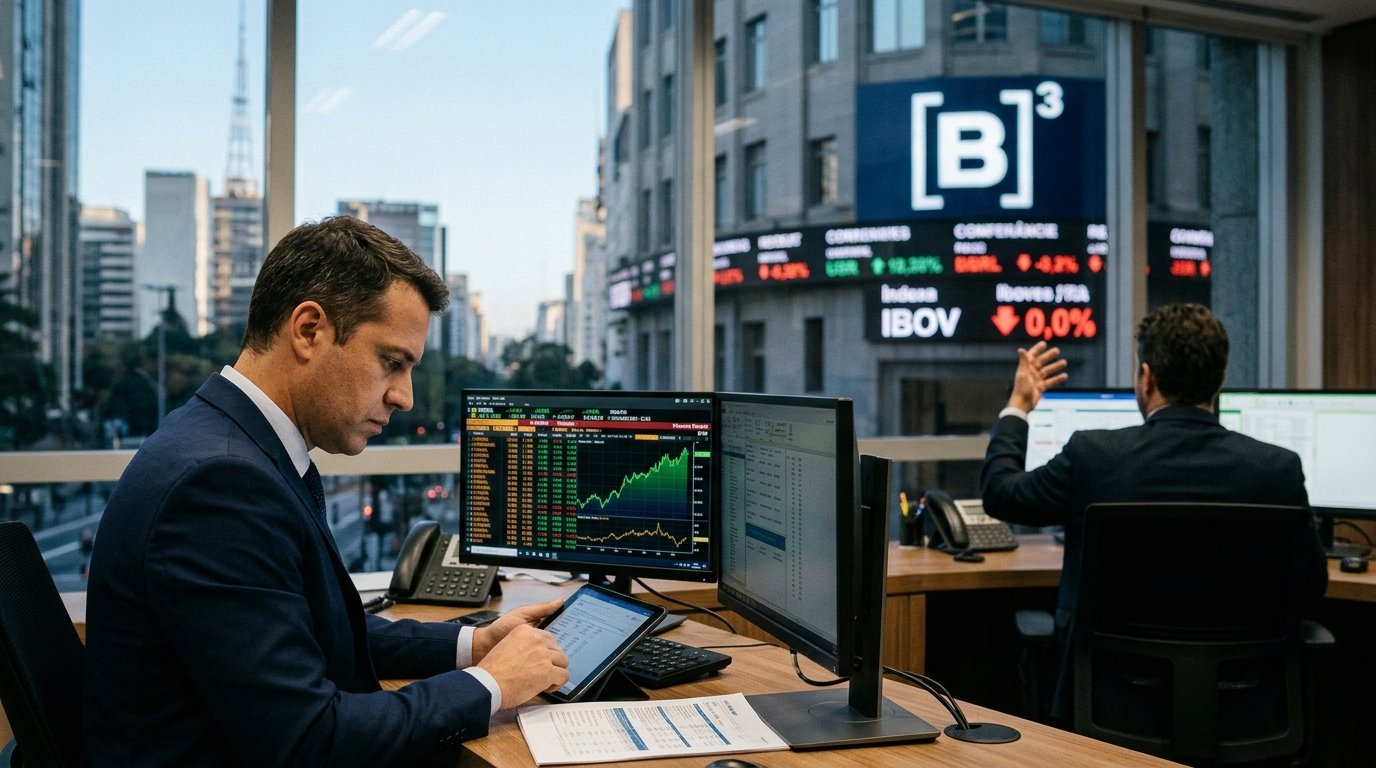
Currency markets and equity markets looked at exactly the same appointment Friday and reached opposite conclusions. That is not noise. It is a question.
Brazil’s real and the U.S.-listed shares of its biggest banks jumped on Friday, a day after the presidency confirmed Luiz Carlos Trabuco Cappi, chairman of Bradesco, as the next finance minister. The real strengthened from about R$5.88 per dollar on Wednesday to about R$5.54 on Friday. That is roughly a 6% move over two sessions, and it happened against the dollar while most of the world sat out a U.S. Thanksgiving holiday.
The ADR market told a similarly strong story. XP gained 18.07%, Banco Bradesco’s ADR rose 15.23%, and Itaú Unibanco climbed 11.34%. U.S. markets were closed Thursday for Thanksgiving, so American-traded receipts of Brazilian shares had to catch up in a single session. Some of that move is arithmetic, not conviction.
The Ibovespa is where the story gets interesting. The index did surge early in the session, but it ultimately finished slightly lower on the day. The real held its gains. The index did not. That split deserves more than a footnote.
One explanation: the real is a direct bet on fiscal credibility, while the Ibovespa is a broader index with material exposure to commodities, exporters, and domestic consumption. A stronger real actually compresses the local-currency earnings of commodity exporters and trims the competitive edge of Brazilian manufacturers selling abroad. A stronger real lowers the cost of dollar-priced inputs for Brazilian buyers and trims the local-currency revenue of exporters of commodities such as coffee and sugar. The index contains both winners and losers from currency strength. The currency itself is only a winner.
Trabuco, a prominent banker and chairman of Banco Bradesco, is seen as a reassuring choice for investors, signaling a pragmatic economic governance approach for Lula’s fourth term. Analysts have described his nomination as one of the most positive policy signals since Lula’s re-election, suggesting a tilt toward more responsible fiscal policy. Bradesco BBI upgraded its rating on the Brazilian stock market from neutral to overweight, citing increased fiscal credibility.
The fiscal challenge underneath all of this is real, though. Recent market and media commentary has put Brazil’s deficit near 10% of GDP and gross public debt near 83% of GDP, and Trabuco’s arrival could shape negotiations with Congress over spending limits and the 2027 budget. A finance minister who cannot spend from the left and cannot cut from the right is a minister working in a narrow corridor.
Analysts at Citigroup have also warned against assuming that a sharp market rebound automatically signals a structural change in Brazil’s economic outlook.
What to watch: whether the real holds roughly R$5.50 to R$5.60 into next week, whether the Ibovespa can reclaim 180,000, and what emerges from Lula’s remaining cabinet announcements after the Mercosur summit in early December. If those picks disappoint, the currency’s vote of confidence on Friday will be the first thing the market revisits.