
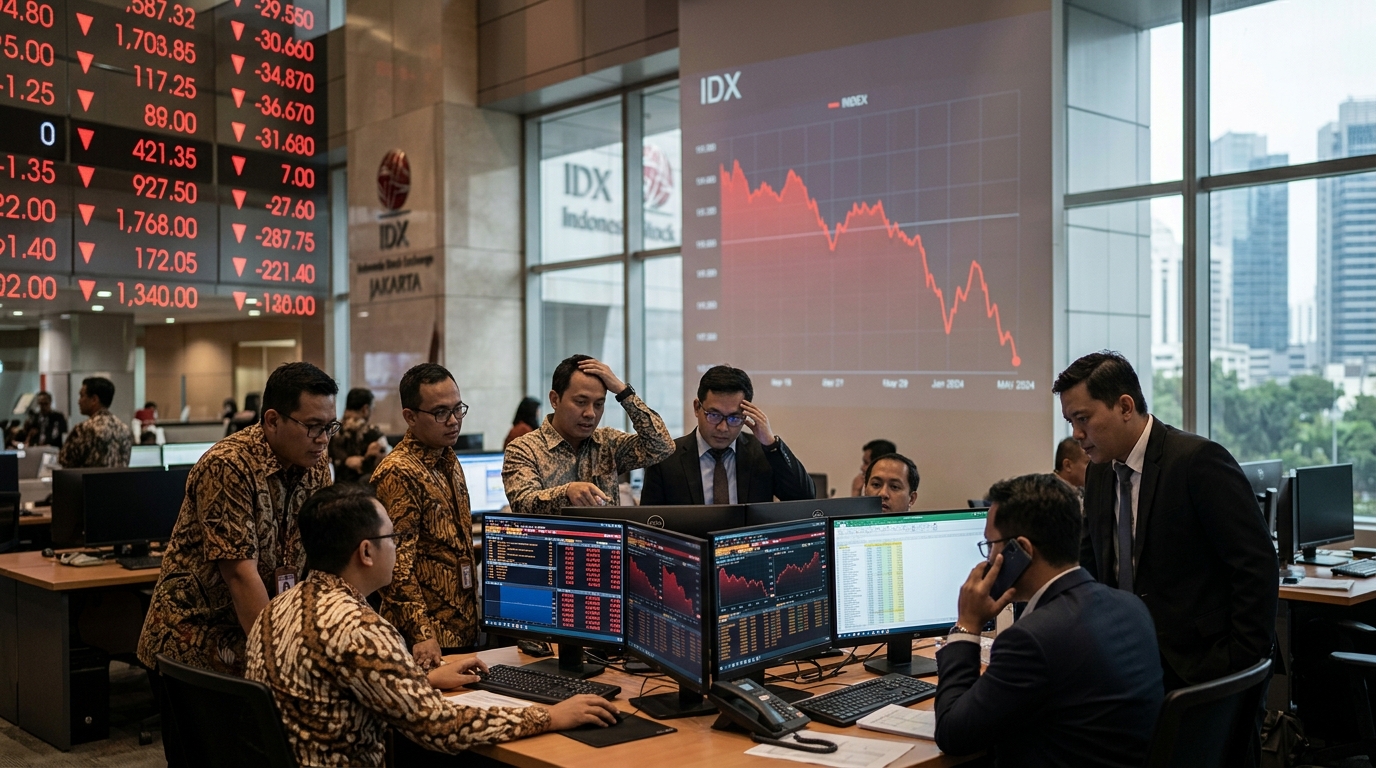
Indonesia’s benchmark stock index plunged more than 5% on Monday to its lowest level since 2020, as concerns over a potential MSCI downgrade intensified fears of further foreign investor outflows. That makes two sessions, roughly 17% of market value, gone since Friday. The question worth asking now is not whether Jakarta deserves the punishment. It probably does. The question is which market sits in a similar chair without knowing it.
Goldman Sachs warned in a Sunday note that a full removal from MSCI’s emerging-market indexes could trigger approximately $5.6 billion in passive fund outflows, equivalent to 18 days of average daily trading volume for constituents of the MSCI Indonesia Investable Market Index. An additional $2.7 billion could be at risk if FTSE Russell subsequently takes similar action. On top of that, active funds benchmarked to MSCI and FTSE indexes hold more than $8 billion in Indonesian equities, although any selling by these investors would be discretionary rather than automatically triggered by a downgrade. Discretionary, yes. But discretion tends to compress when index funds are already selling and liquidity is thin.
What the Market May Be Missing
A downgrade would send Indonesia from emerging-market status to standalone, a two-step cut. Russia is the instructive comparison. When MSCI moved on Moscow after the invasion of Ukraine, the selling was swift and irreversible. Indonesia’s situation is different in origin but structurally similar in mechanics: forced passive outflows hitting a market that foreign investors were already leaving.
Foreign investors have net sold $4.88 billion worth of Indonesian stocks so far this year, on track for the biggest annual outflow in at least 16 years. It is the latest of a series of setbacks for Indonesia this year, with Moody’s and Fitch cutting their sovereign rating outlooks to negative. The governance concerns MSCI named are not new: MSCI said market participants raised investor concerns about persistent opacity in shareholding structures and suspected coordinated trading behavior, and that sufficient progress has not been observed consistently across the market. MSCI raised the prospect of a frontier downgrade in January and was ignored. The standalone proposal is what happens when a regulator runs out of patience.
S&P Global Ratings sovereign analyst Rain Lin said MSCI’s latest warning was likely to result in additional capital outflows but did not anticipate them to be of a magnitude that would materially increase financing costs. “More concerning is the potential damage to investor confidence and the risk that sentiment weakens more broadly across government bond markets and foreign direct investment.” That framing matters. The equity loss is visible. The secondary effects on bond spreads and inbound capital take longer to price.
Where It Shows Up
The most direct exposure for non-Jakarta investors sits in EIDO, the iShares MSCI Indonesia ETF. EIDO closed at $9.94 on October 16, down about 14.9% on the session. The fund is heavily concentrated: financials account for about 51% of market value, followed by energy near 12% and materials near 12%. During the consultation, MSCI will keep freezing certain index-related changes for Indonesian securities. Feedback is due by April 30, 2027, with a final decision due on or before June 30, 2027. That freeze matters for any fund that runs against the benchmark. New money cannot flow in mechanically even if sentiment turns.
Goldman maintained its underweight rating on Indonesian equities, citing persistent index uncertainty, weak corporate earnings and macroeconomic headwinds. The rupiah adds another layer: pressure has extended beyond the equity market, with the rupiah weakening toward 18,000 per U.S. dollar, close to its record low.
Risks and Counterpoints
MSCI has said it will announce its final decision by the end of June 2027, with the potential reclassification hinging on whether Indonesian authorities can demonstrate meaningful improvements in market governance and transparency. Indonesia’s senior economic minister, Airlangga Hartarto, said there was “a big question mark” over why MSCI did not discuss the downgrade to standalone status during a recent meeting, and a session of top officials including the finance minister, the central bank governor and financial regulators was convened to discuss the announcement. A credible regulatory response could slow the selling. Markets, as they usually do after shocks of this magnitude, are likely pricing in the worst outcome before it arrives.
The harder point is structural. MSCI said it could proceed with the reclassification unless the consultation shows clear evidence of material improvements in market governance and functioning. The burden of proof now sits with Indonesian regulators and the exchange.
Proving that to a skeptical index provider, in eight months, with a market already down 40% on the year, is a high bar. Elsewhere in emerging markets, any country where governance scores are soft and liquidity is thin should treat Jakarta’s two sessions as a live demonstration of how fast the exit gets crowded.
What to Watch Next
The Indonesian government’s formal response to MSCI in the coming days will set the tone. Watch whether the Financial Services Authority moves beyond the 2.1 trillion rupiah in fines it levied Friday against firms linked to alleged trading manipulation, toward structural reforms MSCI has actually demanded. The rupiah at the 18,000 level is a secondary pressure gauge. And for any broad emerging market allocation, the MSCI Emerging Markets Index constituent review cycle through the end of 2026 deserves closer scrutiny than usual.