
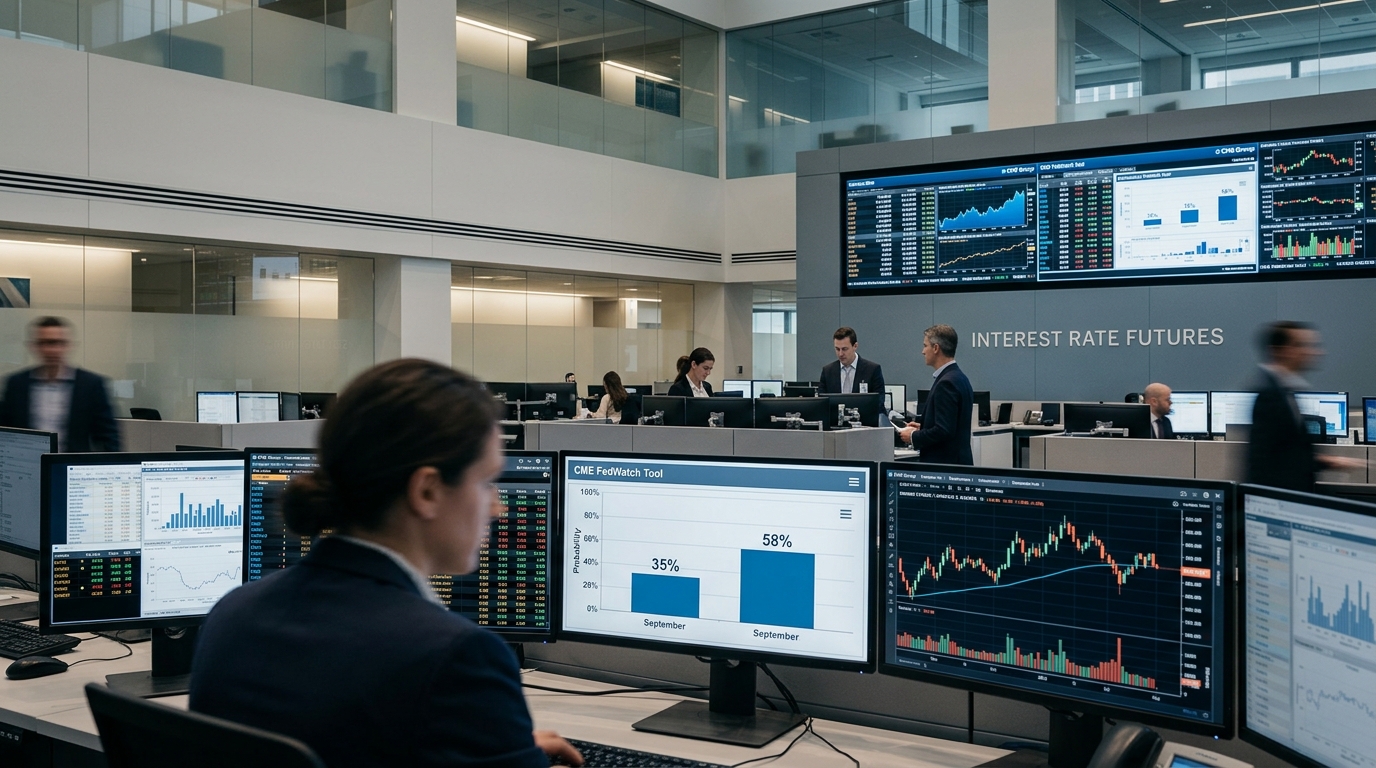
Every percentage point that September rate hike odds swing on the CME FedWatch Tool is, in a very direct sense, revenue for CME Group. The market spent the last week of August resetting the entire short end of the curve in real time, and the exchange that hosts those contracts collected the activity on both sides of the argument. That is the business model, and right now it is running at record speed.
Why This Stock Now
Fed Chair Kevin Warsh’s Jackson Hole address on August 28 opened the door to potential rate hikes in the coming months, and markets reacted quickly. Traders raised the implied probability of a 25-basis-point rate hike at the September meeting to about 55.7% in that session, and by the close CME FedWatch was showing roughly a 57.5% probability of a 25-basis-point hike, up from about 35.4% the day before. That kind of violent resetting is precisely the environment that fills CME’s order books.
The August volume report lands this week. It is the most important near-term catalyst for the stock, and it arrives into a market that already knows the rates complex was extraordinarily active through the month.
The Business
CME Group is the infrastructure layer beneath the Fed debate. When institutions need to hedge rate exposure, express a view on SOFR, or trade fed funds futures against a live FOMC decision, they do it on CME. The company earns a fee on every contract, and volume is the primary driver of that fee income.
The short end of the curve has been the standout: CME’s August 2026 Rates Recap said 2-year Treasury options crossed the 100,000 average daily volume milestone year-to-date, up 92% year over year, with average daily open interest reaching 770,000 contracts as of July 30, up 117% year over year. That is not a modest acceleration. It reflects a structural shift in how professional money is managing rate risk, with the 2-year sitting at the epicenter of every Fed timing debate.
Treasury Weekly options average daily volume increased to 667,000 contracts, up 13%, with open interest rising to 1.7 million, up 36% year-to-date. Tuesday and Thursday weekly options were particularly striking, with year-over-year growth of 98% and 152% respectively. The market is not just hedging, it is hedging at weekly granularity, which compounds CME’s per-meeting revenue opportunity.
Why Wall Street Is Paying Attention
In the first half of 2026, CME said it delivered record first-half revenue, adjusted operating income, adjusted net income, and adjusted earnings per share, powered by record trading in Q1 and its second-highest Q2 volumes ever.
March set the all-time monthly record at 41.1 million contracts average daily volume, up 33% year-over-year. June set a new June record at 30.6 million contracts, up 19% year-over-year. July came in at 27 million contracts, the highest July on record, up 23%. Q2 adjusted earnings came in at $2.99 per share against a $2.91 consensus, with revenue of $1.71 billion versus the $1.68 billion estimate.
The August figure, arriving in the first days of September, will either confirm that the Fed uncertainty of late August sustained the pace, or reveal a summer slowdown. Given what the rates recap data already shows about 2-year Treasury options activity through July, the burden of proof favors continuation.
What’s Driving the Opportunity
CME’s rates business benefits from genuine two-sidedness in the policy debate. As Warsh has emphasized keeping inflation on a clear path back to 2%, markets have been more sensitive to each new datapoint and each major Fed communication, and that sensitivity shows up first at the front end of the curve.
Every time that consensus shifts, every time a Warsh speech or a CPI reading scrambles the curve, traders reach for CME’s rate products. CME has also highlighted the institutional pull of its clearing ecosystem, including swaps-futures portfolio margin efficiencies that it has said are running near $12 billion a day, which signals deep engagement with CME’s infrastructure, not just short-term speculative activity. Stickier institutional flows are harder to lose to competitors.
What Could Go Wrong
The stock is not cheap. CME closed at $285.50 on August 31, 2026, with the 52-week high at $329.16 set on March 3, 2026. Deutsche Bank downgraded the stock to Hold on August 19 after the rally, citing less upside at current levels.
The core risk is resolution. If the Fed hikes in September and the market quickly prices in a long pause, the urgency driving 2-year options volume could fade. A calmer rate environment is the single scenario that most clearly pressures CME’s revenue trajectory.
The Bottom Line
CME Group is not a bet on whether the Fed hikes. It is a bet that the Fed debate stays loud, and right now it is the loudest it has been all year. Warsh used his Jackson Hole speech on August 28 to keep the possibility of rate hikes in play if inflation does not cool convincingly, and the probability swings that followed are exactly the mechanism that drives CME’s revenue. This week’s August volume report is the next concrete data point. If it follows the pattern of every month since January, the investment case gets stronger. If it softens, the market will hear about it immediately. Either way, today is the right moment to be watching.