
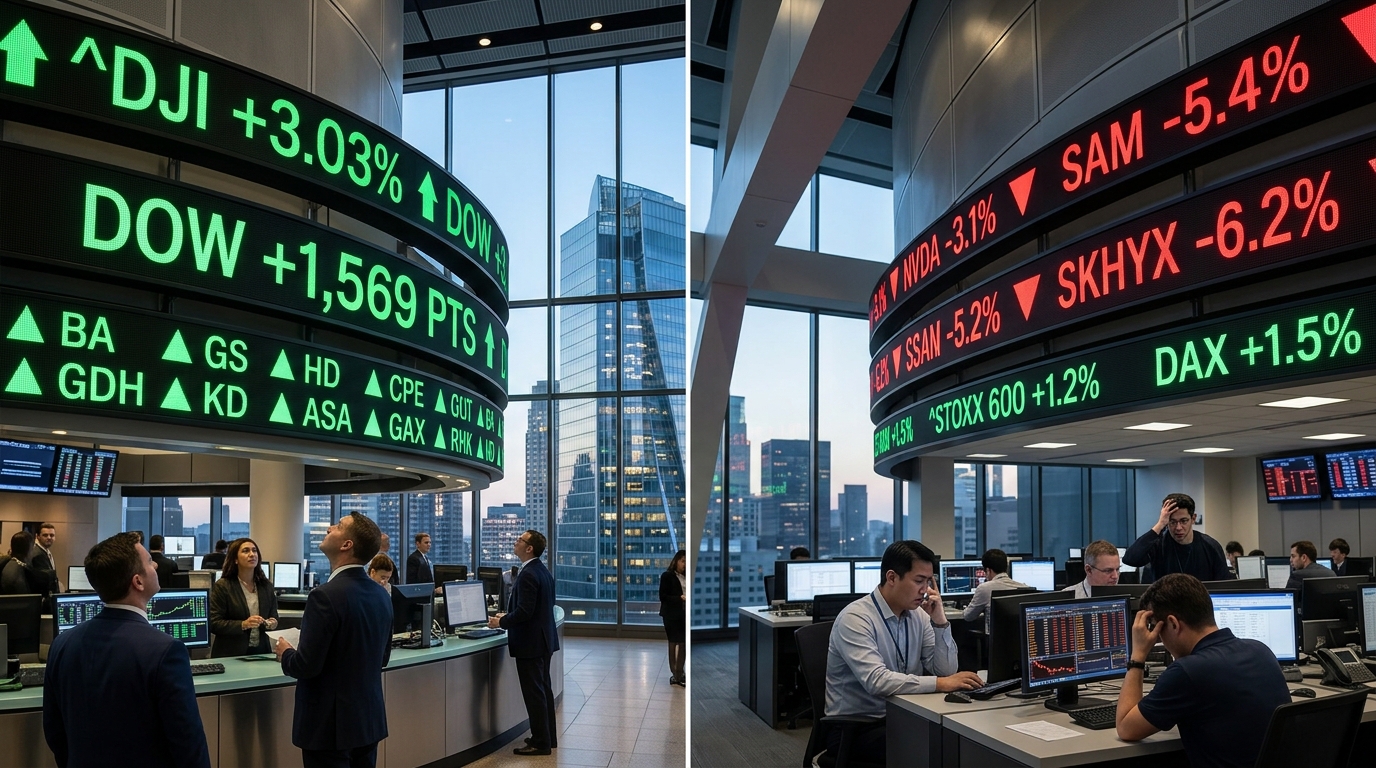
The same news that sent the Dow Jones Industrial Average up 1,569 points on Wednesday erased about $144 billion of combined market value from Samsung and SK Hynix overnight. Both reactions were rational. That is what makes this worth reading carefully.
The Dow closed up 3.03% at 53,356.12 on Wednesday, the day after Democrats won majorities in the House and Senate in the midterm elections. It was the index’s best day since April 2025. And yet technology stocks split: Nvidia fell about 3%.
Big Tech still rallied. Microsoft rose 6.7% and Amazon climbed 6.1%, as investors appeared to wager that a Democratic Congress would limit the AI spending surge.
That internal contradiction is the signal. The Dow rose because political uncertainty cleared, oil fell, and healthcare and financials surged on expectations of policy reversal. Nvidia fell because the index’s composition masked what was actually being sold.
Samsung Electronics and SK Hynix ended Nov. 5 about $144 billion lower in combined market value. SK Hynix closed down about 9.4% and Samsung down 7.6%, while the KOSPI closed down 5.3% at 5,383.80. The two semiconductor heavyweights together account for a huge share of the KOSPI, which explains why a sector call became a country call.
The mechanism connecting Washington to Seoul runs through high-bandwidth memory. Samsung and SK Hynix are major suppliers of high-bandwidth memory used in AI accelerators and data-center systems. When investors reassess how many data centers get built, and how fast, that reassessment lands directly on the chip suppliers who had been pricing in an uninterrupted buildout.
Governors-elect in Texas, Georgia and Ohio, all Democrats, made data center regulation a key part of their campaigns. Texas alone accounts for about a quarter of U.S. data center capacity in the works, which is why the Texas result added pressure to the AI trade. Wells Fargo had warned that a Democratic win in Texas could be a “left-tail event” for the AI trade.
Meanwhile, European stocks surpassed their previous closing record, in an outperformance driven by a rotation out of the artificial intelligence trade and a strong earnings season. The Stoxx Europe 600 rose 0.7%, trading above its prior record, with miners and consumer-products stocks leading gains. Europe’s relative underweight in AI infrastructure names, long viewed as a structural disadvantage, became the reason it outperformed.
Since early October, the pan-European benchmark has outperformed the MSCI All Country World Index and is poised to post its strongest quarterly relative performance since Q1 2025. The rotation is real and has been building for weeks.
Analysts doubt any legislation could meaningfully stall data-center construction. Any Democratic legislation would still require President Trump’s signature to become law, a check that limits near-term legislative risk. That constraint, however, does not fully neutralize the chilling effect on capital allocation that uncertainty alone can produce. That is the operative phrase: uncertainty resets faster than legislation moves.
The question for the coming weeks is whether this is a rotation or a regime change. Rotations reverse when sentiment clears. Regime changes do not. Investors will be monitoring policy announcements from newly elected officials, developments in data-center permitting and broader financial conditions to assess whether the latest sell-off reflects a temporary reaction or a more sustained change in the outlook for AI infrastructure. Watch Texas specifically. If new permitting rules move from campaign promise to draft legislation, what looked like a one-day trade in Seoul becomes a structural reset of every stock sitting on top of the AI buildout.