
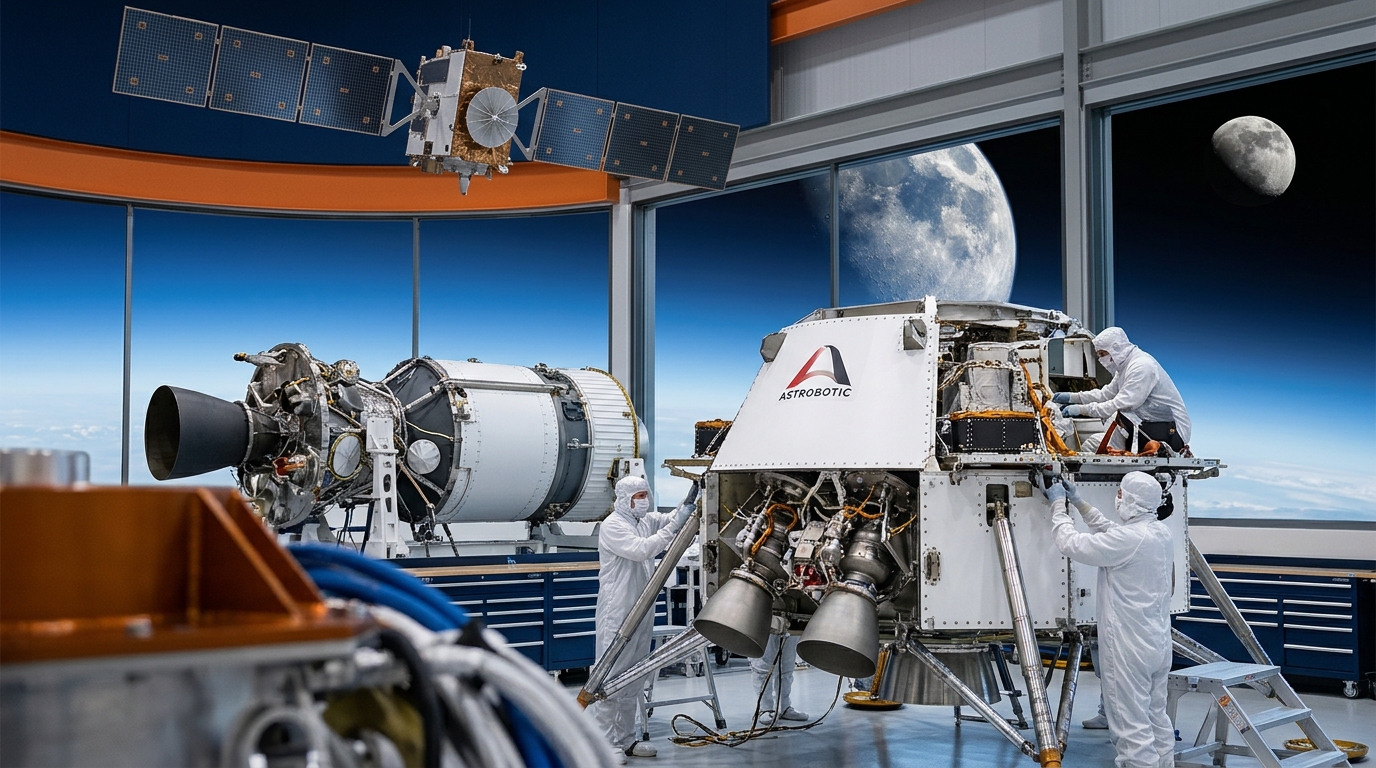
The investment thesis had real logic behind it: Amazon, racing to complete a 3,236-satellite low-Earth-orbit constellation now rebranded Amazon Leo, would eventually need more than rocket launches. It would need reliable orbital and planetary logistics infrastructure. Astrobotic, with its Griffin lander, LunaGrid lunar power distribution work, and nearly two decades of NASA relationships, looked like the right asset. The problem is that Voyager Technologies got there first.
Voyager closed its acquisition of Astrobotic on July 10, 2026, with consideration valued at $300 million under the deal terms, in a mix of cash, stock, assumed debt, and contingent consideration. The deal transformed Voyager into a full-stack lunar infrastructure provider, giving it direct control of Astrobotic’s Peregrine and Griffin surface lander programs and its LunaGrid power distribution work. Weeks after the deal closed, Astrobotic announced two additional NASA task orders for CLPS Moon Base missions. The asset got more valuable the day it changed hands.
Amazon Leo’s own deployment problems make the timing sting more. United Launch Alliance’s Vulcan, which holds the largest share of Amazon’s remaining launch contracts, has not flown since a solid rocket motor nozzle anomaly on a February 12, 2026 mission, and Blue Origin’s New Glenn was lost in a pad explosion during a hotfire test on May 28, 2026. The FCC granted a waiver with conditions that temporarily demote the spectrum priority of Amazon Leo satellites deployed after the July 30, 2026 milestone deadline, until Amazon has 1,616 deployed and operating or until March 30, 2028, whichever comes first. Amazon is managing a constrained supply chain across five rocket families simultaneously, and the one company that had cracked repeatable lunar surface delivery just left the board.
The second-order question is whether Voyager itself becomes the acquisition. At a $300 million deal value for Astrobotic and full-year 2026 revenue guidance raised to $275 million to $305 million, Voyager is not a rounding error, but it is not a serious obstacle to Amazon’s balance sheet either. The combined Voyager platform now spans mission management, communications, propulsion, surface delivery, surface power, habitation, dust mitigation, and in-situ resource technologies, precisely the vertical stack that becomes relevant as Amazon Leo eventually needs to coordinate with lunar relay infrastructure and deeper orbital nodes.
Amazon will not buy Voyager for Leo alone. The strategic rationale sharpens when you consider that Amazon has agreed to acquire Globalstar, aiming to add direct-to-device satellite connectivity capabilities. A company assembling a full connectivity platform from low Earth orbit to enterprise edge has reasons to care about what sits beyond LEO, particularly if competitors or governments start routing communications through lunar relay points in the 2030s.
The cleaner near-term read is simpler: the Astrobotic window closed, and Voyager is the residual. Astrobotic’s own rotating detonation rocket engine tests earlier this year showed the propulsion technology was being developed for use on future lunar landers and in-space orbital transfer vehicles. That engineering is now inside Voyager. Watch whether Amazon makes a move on Voyager before Griffin Mission One launches later this quarter, because after a successful lunar surface delivery, the price will not stay at a startup multiple.