
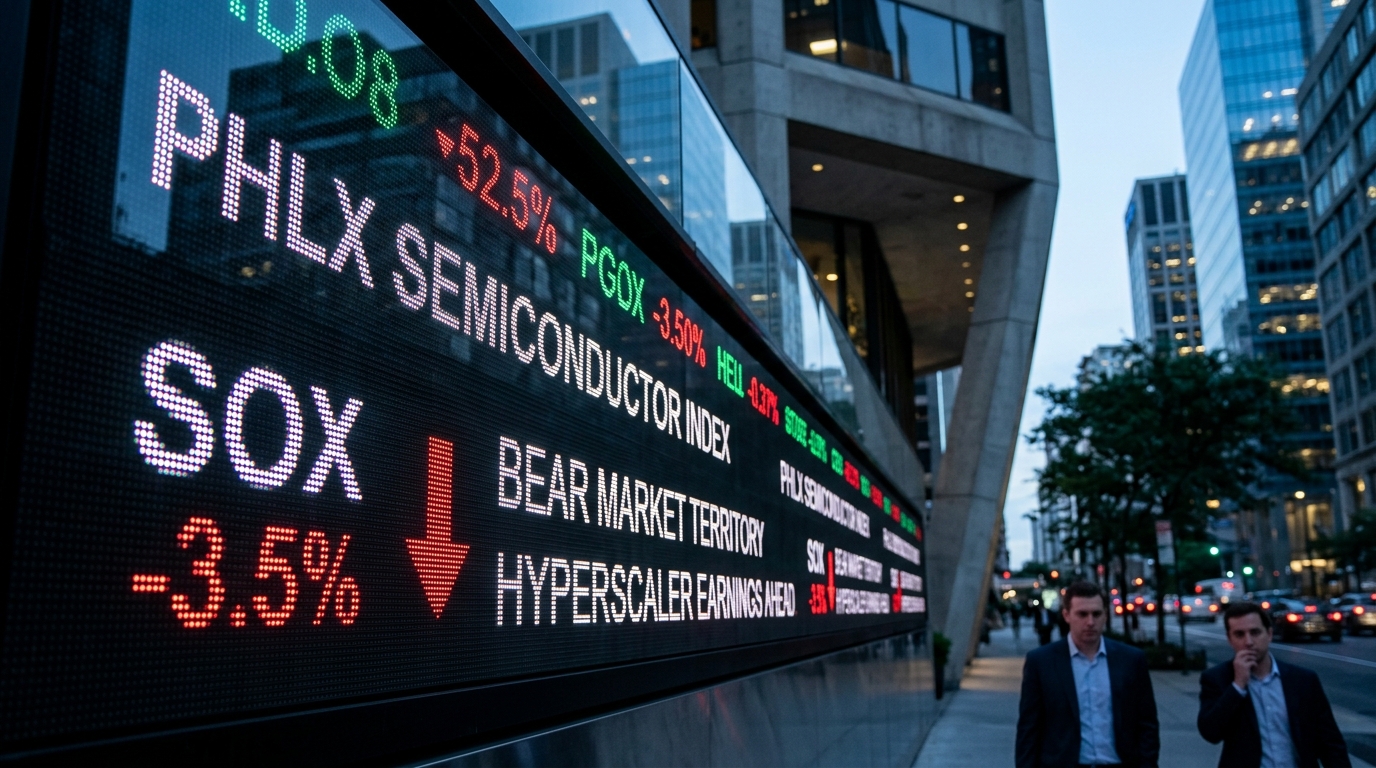
Here is where things stand right now. The Philadelphia Semiconductor Index has shed more than 20% from its late-June record high, crossing the technical threshold that defines a bear market. This week’s rout is on track to be the worst for the chip sector since the April 2025 tariff meltdown. And it all started with something most investors weren’t watching closely enough.
A Chinese AI startup just changed the conversation again.
Moonshot AI unveiled Kimi K3 at the World Artificial Intelligence Conference in Shanghai on July 17 — a 2.8 trillion-parameter open-weight model that the company says is the world’s largest of its kind, rivaling top-tier offerings from OpenAI and Anthropic on key benchmarks. It is a significant jump from its predecessor K2, which carried 1 trillion parameters. The model showed particular strength in front-end coding tasks, a category that matters enormously to enterprise developers. Full open weights are scheduled for public release July 27.
The market reaction was immediate and global. Taiwan’s benchmark index closed down more than 6%. Japan’s Nikkei fell 4%. The Nasdaq dropped 1.5% and the S&P 500 fell roughly 0.7% to around 7,534 on Friday. Shares of Applied Materials, Lam Research, Intel, KLA Corp., and Arm Holdings each fell approximately 4%. Nvidia dropped more than 2%, temporarily ceding its title as the world’s most valuable company to Apple.
Slight tangent, but it matters: this isn’t the first time a Chinese open-weight model sparked a crisis of confidence in the U.S. AI infrastructure trade. The DeepSeek moment in early 2025 produced an almost identical playbook — cheaper model, brutal selloff, then a recovery as demand fundamentals held. The question this time is whether the pattern repeats or breaks.
What’s Actually Driving This
The Kimi K3 release didn’t cause this selloff by itself. It accelerated a rotation that was already in motion. The SOX had gained roughly 105% between its March low and late June’s all-time peak — a historically extreme run that left the sector pricing near-perfection on AI capex assumptions. The valuation math was always fragile at that level.
Three pressure points converged this week:
- China’s AI competitiveness: Moonshot’s Kimi K3, backed by Alibaba (which invested $1 billion into Moonshot in 2024 at a $2.5 billion valuation — now reportedly at $31.5 billion), signals that open-weight models from Chinese labs are closing the gap with U.S. frontier systems at a fraction of the cost. Open-source models can directly undermine the subscription economics of closed U.S. AI systems.
- Hyperscaler capex anxiety: Reports surfaced this week of revised capital expenditure forecasts from major cloud providers. Marvell Technology, which derives 76% of total revenue from its data center segment, absorbed some of the worst damage — down 31% over the past month despite a 125% year-to-date run. The company still reported record Q1 revenue of $2.4 billion and guided Q2 revenue growth of roughly 35% year over year. Fundamentals didn’t change. The market’s willingness to pay for those fundamentals did.
- Alphabet’s Gemini delay: Bloomberg reported Thursday that Alphabet is behind schedule on releasing Gemini 3.5 Pro, its most powerful flagship model. That news — landing on the same day as Kimi K3’s debut — reinforced fears that U.S. AI leaders are struggling to maintain their pace even as Chinese competitors accelerate.
The Marvell Situation Is Worth Understanding in Detail
Marvell designs the custom silicon, high-speed optics, and Ethernet switches that hyperscalers use in AI data centers. That 76% data center revenue concentration means every hyperscaler capex headline is, functionally, a Marvell headline.
The stock now carries a trailing P/E of roughly 65 to 74 times. At that multiple, the market priced in a virtually uninterrupted ramp across Amazon’s Trainium 3 processor (second-half 2026 volume ramp expected) and Google’s “Merope” LPU program, which KeyBanc projects could generate up to $12 billion over its lifecycle. KeyBanc upgraded MRVL to a $400 price target on July 14 — right into the teeth of a reversal that has shares down over 33% from their June 2026 high of $316.43.
CEO Matt Murphy raised both fiscal 2027 and 2028 outlooks, with design win activity described as reaching an all-time record across 50-plus custom AI opportunities and more than 10 customers. The fundamentals are intact. The valuation reset is the event.
Arm Holdings, Intel, and other names with elevated AI-premium multiples are in a similar position. Arm and Intel are each down more than 30% from their recent highs. The SOX’s semi ETF (SOXX) is off more than 17% for the month alone as of Friday’s early session.
The Macro Backdrop Is Not Helping
It’s not just China and capex fears. The macro environment is adding its own friction. WTI crude surged roughly 12% for the week to around $80 per barrel as escalating U.S.-Iran hostilities disrupted flows through the Strait of Hormuz — with confirmed crude transit falling 62% to 4.1 million barrels per day. Brent hovered near $85. Energy and utilities are the sectors leading the S&P 500 today while technology and communication services are the laggards.
Consumer sentiment improved — the University of Michigan’s preliminary July reading came in at 54.4, up 10% from June’s 49.5 and above the consensus forecast of 51 — driven by easing gasoline prices. Retail sales rose 0.2% in June year over year, up 6.7%. Initial jobless claims fell to 208,000 for the week ended July 11, below the consensus estimate of 217,000. The economy isn’t falling apart. The rotation away from premium-multiple tech into defensives, energy, and financials is about valuation and positioning, not economic collapse.
The Philly Fed manufacturing index jumped to 41.1 in July from 10.3 in June — a surge that adds texture to the case for industrials and cyclicals absorbing capital rotating out of chips. The S&P 500 Equal Weight Index is actually up slightly over the past month — a sign that money is moving into lower-market-cap stocks, not leaving equities entirely.
Sector Breakdown
The divergence is clean. While XLK (tech) and XLC (communication services) were each down roughly 1.8% and 2.9% on Thursday, Consumer Staples (XLP) rose 2.9%. Utilities and energy lead major sectors on Friday. The rotation is firm and accelerating — from momentum tech into economically sensitive shares. Small caps (Russell 2000) are essentially flat this week while the Nasdaq has shed roughly 1.8%.
The retail sector is quietly outperforming. The SPDR S&P Retail ETF (XRT) has gained just over 2.5% this week even as tech collapsed. That is a meaningful divergence and worth tracking as a tell on consumer resilience separate from the AI trade.
For traders watching specific names: Nvidia is down roughly 2.4% in premarket Friday, Amazon is off 2.1%, Meta is down 1.8%, and Tesla is falling 1.7%. Every member of the Magnificent Seven is in the red today. The VIX crossed 16.73 Thursday, up 6.8%, approaching 17 again — elevated but not yet a regime-change signal.
The Real Decision Point Is Not Today
Here’s the thing. The chip selloff’s next true inflection is not the Kimi K3 reaction — that is the catalyst, not the verdict. The verdict comes from the hyperscalers themselves. Alphabet reports July 22. Tesla reports July 22. Intel reports July 23. Meta and Microsoft report July 29. Amazon reports July 30.
These earnings calls will either reaffirm that AI capex is expanding as planned — which would likely floor the SOX — or they will introduce language around digestion periods, efficiency improvements, or budget reallocations that could extend the selloff into August. JPMorgan’s desk noted this week that “concerns over hyperscalers’ AI CapEx and the sustainability of the AI rally” are now driving both Magnificent Seven and semiconductor stocks simultaneously — a broadening of the pressure that didn’t exist in earlier pullbacks.
Schwab’s market update put it plainly this morning: the chip volatility looks more like “a valuation and positioning reset than the end of the AI infrastructure cycle.” That framing is probably right. The SOX gained 105% in roughly three months. A 20%-plus drawdown within that move is not structurally unusual, especially when multiple sentiment shocks hit at once.
Three Scenarios Heading Into Next Week
Bull Case: Alphabet and other hyperscalers confirm sustained AI capex commitments on July 22 calls, Kimi K3 benchmark claims fail to hold up under independent testing after the July 27 open weights release, and chips stabilize at current levels with the SOX finding a floor near the 200-day moving average. MRVL and ARM recover sharply. Target: SOX reclaims 50% of the drawdown within 3 to 4 weeks.
Base Case: Hyperscaler guidance is roughly in line but cautious in tone. Management teams acknowledge efficiency improvements in AI model training — reducing the urgency of new hardware purchases — without cutting absolute spending. The SOX stabilizes but remains range-bound below June highs into August earnings season. Rotation into defensives, energy, and industrials continues. Nvidia’s August 26 earnings become the next definitive read on AI infrastructure demand.
Bear Case: One or more hyperscalers reduce AI capex guidance, citing improved model efficiency, internal silicon buildouts, or Chinese competition compressing the ROI case for GPU-dense clusters. Kimi K3’s open weights validate its benchmark claims. The SOX extends the drawdown toward 25% to 30% from peak, with high-beta names like MRVL, ARM, and AMAT suffering disproportionate losses. The AI multiple compression becomes a sector-wide derating that spreads into cloud software.
Active Trader Framework
The immediate technical picture for the SOX is broken below its 50-day moving average, with the 200-day now as the key reference level. Volume patterns this week suggest institutional liquidation, not just retail selling — a distinction that matters for timing any re-entry. The SOXX and SMH ETFs offer the cleanest expression of either direction.
For individual names, Marvell’s compressed valuation (down 31% from peak with fundamentals intact) creates a different risk profile than names still trading near highs. The KeyBanc $400 target implies a roughly 2x from current levels if the Trainium 3 and Google Merope programs deliver on schedule. The risk: if hyperscalers slow or internalize silicon development, that multi-year revenue visibility disappears quickly at a 65x earnings multiple.
On the short side, the AI hyperscaler basket itself — names like CoreWeave that depend on GPU demand staying elevated — faces a more structural challenge if Kimi K3’s efficiency claims translate into real-world deployment. Watch put flow in SOXX, SMH, and NVDA as a real-time sentiment gauge heading into next week’s earnings calendar.
Position sizing matters here. The SOX’s beta-driven moves can swing 5% to 7% in a single session on headline risk. That is not a sector where you size like a utility.
One thing worth watching that most people are glossing over: the VIX is at 16.73 — elevated but not panicked. That gap between the severity of the chip selloff and the relative calm of the broader volatility index suggests this is a sector-specific repricing, not a systemic risk event. That’s either reassuring or a sign the broader market hasn’t fully processed what a sustained capex slowdown would mean for the S&P 500’s earnings trajectory.
The hyperscaler earnings calls next week are not just about individual stocks. They are the most important data point for the entire AI investment cycle since the DeepSeek event. Prepare for both directions.
For informational and educational purposes only. Not investment advice. Trading involves risk, including loss of principal.