
Vestas Wind Systems published its Q3 2026 interim report this morning and delivered a quarter that looked good in the headlines and worse underneath. Revenue came in at €5.7bn with an EBIT margin before special items of 8.5%. That margin compared favorably to 7.8% in Q3 2025. Earnings per share grew 21% to reach an all-time high of €1.14. The stock fell roughly 4% on the day.
Market Snapshot
The selloff tells you what the market focused on. Net profit of €323 million missed analyst consensus of €380 million, revenue fell short of the €6.0 billion estimate, and EBIT before special items of €483 million came in below expectations of €526 million. Adjusted free cash flow fell sharply to €99 million from €508 million, reflecting lower operating cash flow and higher working capital requirements as offshore activity expanded. Those three numbers, together, were enough to override everything else.
Stocks in Focus: VWS.CO
The combination of a double earnings miss, a significant free cash flow contraction, and declining order intake proved too much for the market to absorb, even as the company delivered year-on-year profit growth and an all-time high earnings per share figure.
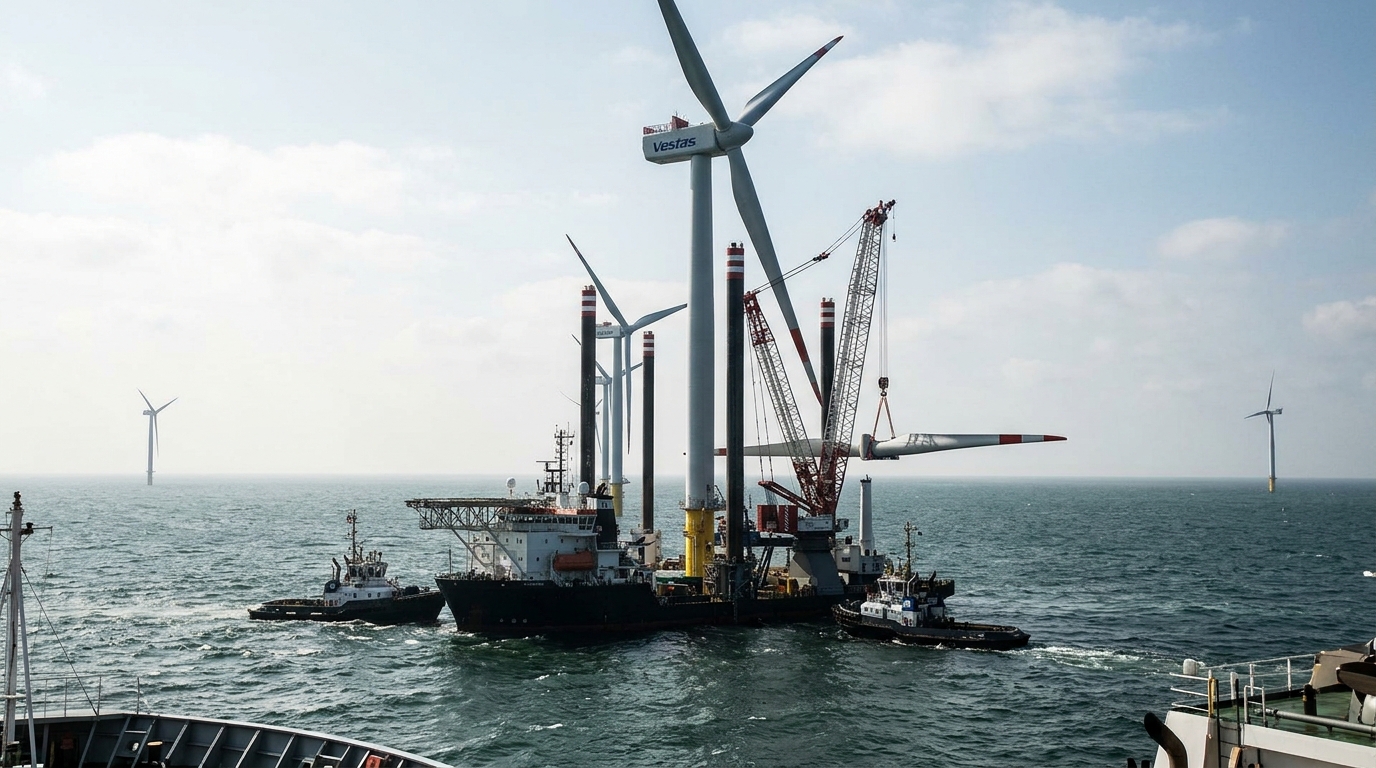
The underlying problem is offshore. Vestas pointed to higher operating costs related to a European offshore project as it continued its offshore ramp-up. The quarterly intake of firm and unconditional wind turbine orders fell 27% from Q3 2025, to 3,377 MW. Vestas also said the decline was primarily due to weaker onshore orders in the U.S.
The backlog is not in question. Vestas held service agreements with expected contractual future revenue of €42.0bn, bringing the combined Power Solutions and Service backlog to €77.9bn, an increase of €9.7bn year on year. Traders should watch whether the gap between that contracted revenue and the market’s reaction closes or widens over the next few sessions.
Sector Watch
European wind is splitting into two stories this morning. Siemens Energy posted record results on the same day Vestas missed, which puts capital allocation pressure squarely on Vestas bulls. Vestas is signaling less upside and less downside for 2026 while it works through offshore ramp-up risks and leans harder on higher-margin service work. Service was the clearest positive: Q3 service revenue beat expectations at €1,019 million versus €892 million expected. If service continues to outperform, the mix shift toward recurring, higher-margin revenue could gradually change the valuation case.
Risk Radar
- Offshore cost overruns: The EBIT margin improvement of 70 basis points was partly offset by higher costs related to a European offshore project. Until that project closes out, it remains an open liability.
- US demand softness: Softer onshore US order activity adds policy risk to execution risk. Any further rollback of federal clean-energy support would pressure the order intake line.
- Free cash flow: A drop from €508 million to €99 million in one quarter signals that working capital consumption from offshore expansion is real and may persist.
The Cheat Sheet
Top theme: Good operations, bad execution on the project that matters most right now.
Stock to watch: VWS.CO. Vestas is continuing its €400 million share buyback program, which launched on 13 August 2026 and runs through no later than 16 December 2026, which puts a floor under the share price mechanically. The question is whether that support holds against persistent offshore cost headlines.
Biggest risk: Vestas narrowed its 2026 revenue outlook to €20.5 billion to €21.5 billion and tightened its EBIT margin forecast to 7.5%-8.5%. Narrowing guidance is usually a confidence signal. Here, the market read it as a ceiling, not a floor.
One thing to remember: A €77.9bn backlog guarantees future revenue, not future margin. Until offshore execution costs stop surprising to the downside, the gap between what Vestas has contracted and what it earns on those contracts is the only number that matters.