
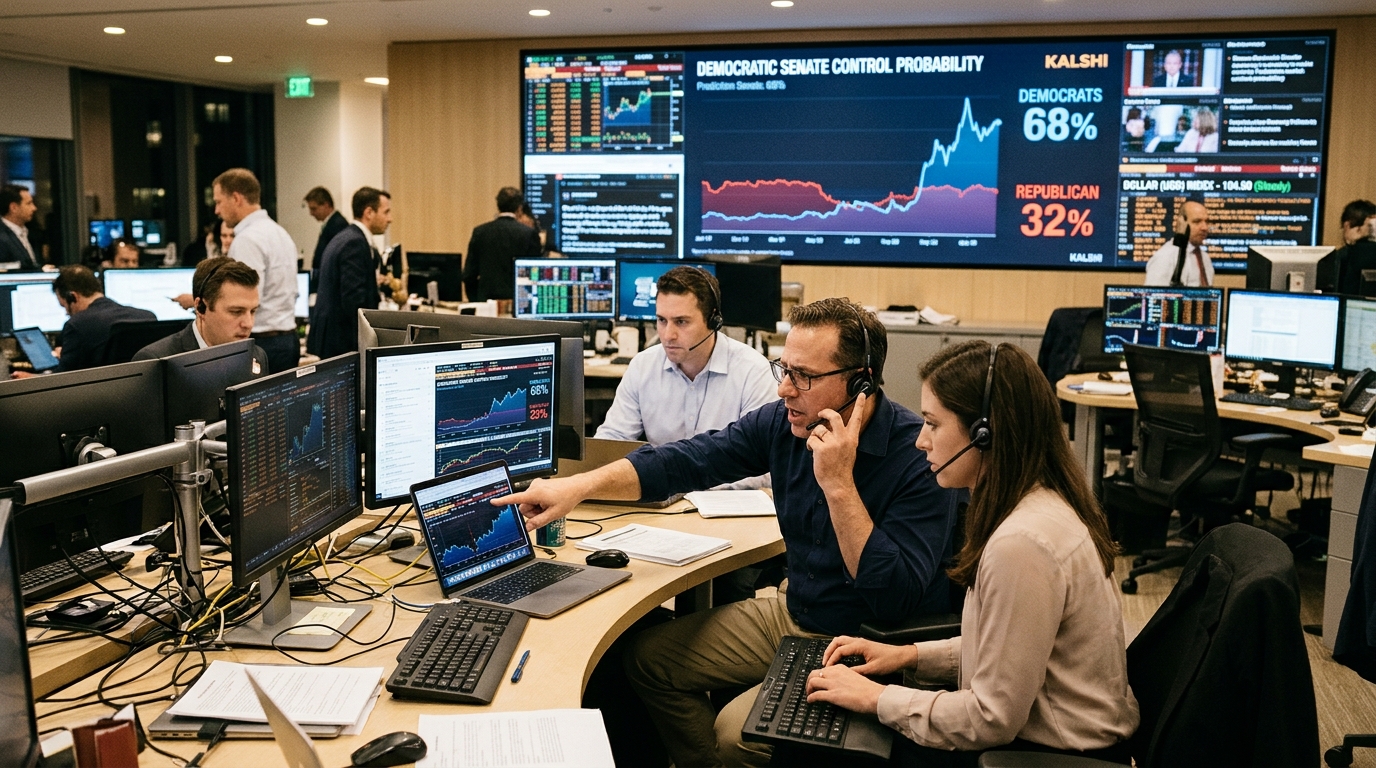
America votes today, and the most important market story is not what traders priced. It is what they did not.
Kalshi now shows Democrats at about 68% to control the Senate, with Republicans around 32%. Monday’s reading was among the highest Democratic Senate probabilities on the platform this cycle, driven by late polling, including a final round of New York Times/Siena College surveys that showed Democratic Senate candidates ahead across seven key battleground states. The House was already consensus: Nate Silver’s final forecast put Democrats around 95% to win the House and roughly 80% to control the Senate.
The Senate move was new. The currency market’s response was not.
The US dollar index steadied around 101.8 on Tuesday after facing heightened volatility in the previous session, as investors turned cautious ahead of the midterms. Strategists at Brown Brothers Harriman have argued that a Democratic win in both chambers could bring a relatively muted initial market reaction, while a Republican Senate hold would be the bigger surprise and could spark more volatility.
That framing is the tell. When a result’s main market consequence would be its failure, there is residual risk that goes uncompensated. Traders paid up for the week of the vote, not the day itself: the VIX rose to 21.15 and nine-day volatility jumped to 22.46, above spot, while one-day implied volatility eased. Options price about 0.86% for today’s session and 1.85% into November 6. The market is hedging the count and the payrolls report Friday, not necessarily the Senate flip itself.
Where the Gap Is
Three specific exposures are worth examining against what the price action actually shows.
First Solar (FSLR). While the broader stock market has enjoyed robust growth so far in 2026, First Solar is down sharply year to date. A big reason traces to the 2025 One Big Beautiful Bill Act, which reduced or eliminated a number of renewable energy tax incentives. A strong Democratic showing could reinforce expectations that federal support for clean-energy development will remain in place, analysts have said, benefiting companies such as First Solar, Sunrun, and NextEra Energy. A Senate flip gives Democrats leverage in debt-ceiling negotiations in early 2027, a genuine legislative lever. That is a distinct outcome from a House flip alone, and it does not appear to be in First Solar’s current price.
UnitedHealth (UNH). The dynamic here runs in reverse. UnitedHealth has said Medicaid margins are likely to remain under pressure in 2026, with modest improvements beginning in 2027. The company has also warned of continued membership attrition into 2027 as states trim rolls ahead of new work requirements and other provisions of the federal budget law known as the One Big Beautiful Bill Act. A Democratic-controlled chamber could not repeal the 2025 law on its own but could use must-pass budget negotiations to seek funding changes or delays to some cuts. For a stock up meaningfully in 2026, the regulatory drag from a Senate majority willing to fight Medicaid cuts in the 2027 debt ceiling is not obviously in the price at current levels.
MP Materials (MP). Rarer, and less covered. Washington’s support for domestic rare earth producers relies in part on Defense Production Act authorities, whose broader expiration was last extended into 2026. Democratic lawmakers have been seeking records from MP Materials and other critical minerals companies as part of broader oversight inquiries. A Democratic sweep would give Congress more say but could make a clash with China less likely, a complicated mix for a stock whose business model depends on bipartisan support for domestic supply chains.
The Counterargument
The danger in all this consensus is that the polls and the prediction markets may effectively be the same signal: political scientists have argued that the second is often largely a reading of the first. Nate Silver has argued that “death by a thousand cuts” could still block a wave, noting Republicans retain many winning combinations. And, in prior cycles, polling has sometimes underestimated Republican performance in the popular vote. A uniform polling error of that magnitude tonight would flip several of the individual Senate races Kalshi currently favors.
The market has priced the expected outcome. What it has not priced fully is the gap between about 68% and 100%. Polls close in Indiana at 6 p.m. Eastern. Early state-level returns from Texas and Iowa, the two races most responsible for the Senate market’s late move, will tell investors within hours whether the price was right.