
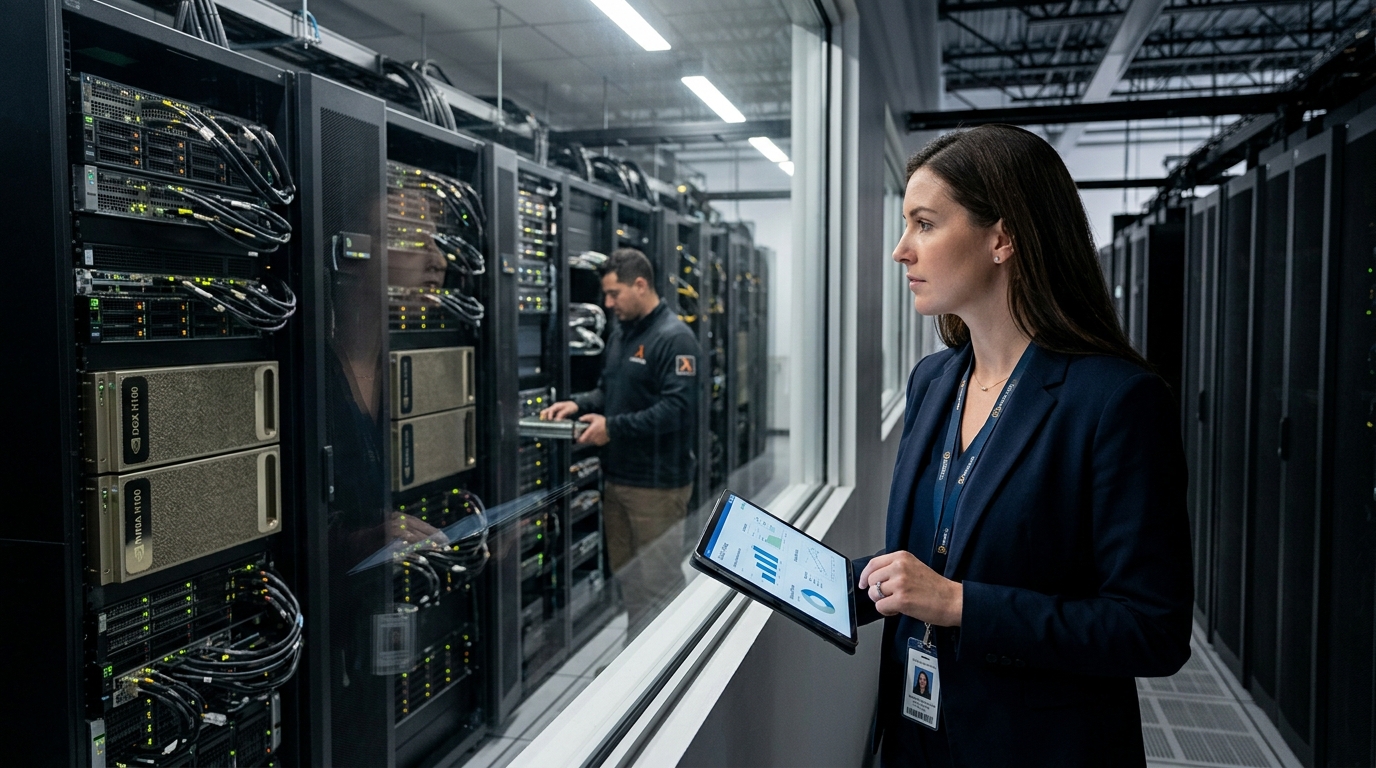
Follow one dollar through Anthropic’s newest compute arrangement and count how many hands it passes through before it reaches a chip. Anthropic commits $35 billion to Lambda, a San Jose cloud provider. Nvidia, which has invested in both Anthropic and Lambda, holds the lease on the Hut 8 facility in Nueces County, Texas, with Lambda then paying Nvidia for access to the site in order to deploy chips and supply computing resources to Anthropic. The financial terms between Lambda and Nvidia have not been disclosed. That is four counterparties stacked on a single transaction, each carrying a slice of risk that nobody has fully priced.
Add the Nscale deal, signed the week before, and the picture sharpens. Anthropic agreed to spend about $45 billion renting AI cloud computing power from Nscale’s West Virginia campus over six years, representing about 460 megawatts of power. The deal is expected to use Nvidia’s next-generation Vera Rubin chips. Both Nscale and Lambda are Nvidia-backed. In the Texas arrangement, when the company that sells the chips also signs the lease on the building they will run in, it is underwriting its own demand forecast.
Taken together with earlier commitments, Anthropic’s total computing deals in 2026 amount to at least $135 billion, including a commitment to spend more than $100 billion on Amazon Web Services over the next decade. Layer in $30 billion committed to Microsoft Azure and $10 billion to Volta Infra in Norway and the number keeps climbing. Anthropic has also signed a $50 billion deal with Fluidstack and a compute agreement with SpaceX that SpaceX disclosure materials indicate could total up to about $45 billion.
The credit question circulating on fixed-income desks this week is not whether the infrastructure is real. Hut 8’s Beacon Point campus has financing behind it. Hut 8 funded the first 352-megawatt phase with $4.25 billion in senior secured notes, non-recourse, carrying a 6.129% coupon and maturing in 2042. The question is whether the entity at the top of that stack, Anthropic, is creditworthy enough to honor what it has signed.
The answer, at present, depends entirely on what happens in mid-October. Bankers for Anthropic are reportedly seeking an investment-grade credit rating after the company’s IPO to cut borrowing costs for its AI projects. Goldman Sachs and Morgan Stanley have reportedly held talks with the three major credit rating agencies about Anthropic being treated as an investment-grade borrower upon listing, which would broaden the pool of buyers for Anthropic debt. Anthropic remains loss-making, with outside analysts and research materials describing profitability as not expected until 2028.
A CreditSights analysis suggests Anthropic’s revenue growth could justify an investment-grade rating only if the company raises roughly $100 billion of fresh capital in its IPO. No decisions have been made; some analysts still describe Anthropic as deep speculative-grade. That gap, between the rating being lobbied for and the rating that the fundamentals currently support, is precisely where the risk lives.
The structure of the Lambda deal tells you who understood that gap first. The arrangement could increase Nvidia’s exposure to the infrastructure supporting demand for its hardware, though the financial terms of its agreements with Hut 8 and Lambda have not been disclosed. Nvidia gets chip sales, lease income, and strategic positioning. Lambda closed a $926 million senior secured term loan B on August 12, 2026, to fund GPU infrastructure for a committed customer deployment with an investment-grade offtaker, language that treats Anthropic as creditworthy before any rating agency has formally agreed. Hut 8 collects long-term lease revenue. Every layer in the chain has protected itself. The layer that has not is whichever investor buys Anthropic bonds at investment-grade spreads on IPO day.
Stocks to Watch
- Nvidia (NVDA): Positioned at every level of the arrangement, as chip supplier, investor in Lambda and Nscale, and anchor leaseholder on the Texas campus. Upside is significant if AI demand holds; exposure to underused infrastructure if it does not.
- Hut 8 (HUT): Collects non-recourse lease revenue from an investment-grade-designated tenant at Beacon Point. The risk is execution: the first phase energizes in early 2027, and the second data hall is not expected until mid-2028.
- Amazon (AMZN): Holds the largest single Anthropic compute commitment at more than $100 billion via AWS. If Anthropic’s revenue scales toward the levels needed to service its obligations, AWS is the primary beneficiary and the primary utilization risk.
- CoreWeave (CRWV): Competes directly with Lambda and Nscale for Anthropic-style anchor tenants. Each deal Nvidia structures through its own portfolio companies narrows the addressable market for independent cloud providers.
- Microsoft (MSFT): Azure holds a $30 billion Anthropic commitment. As one of the senior creditors in everything-but-name, its exposure to Anthropic’s creditworthiness is underappreciated relative to its balance sheet.