
 By Traders Daily Editor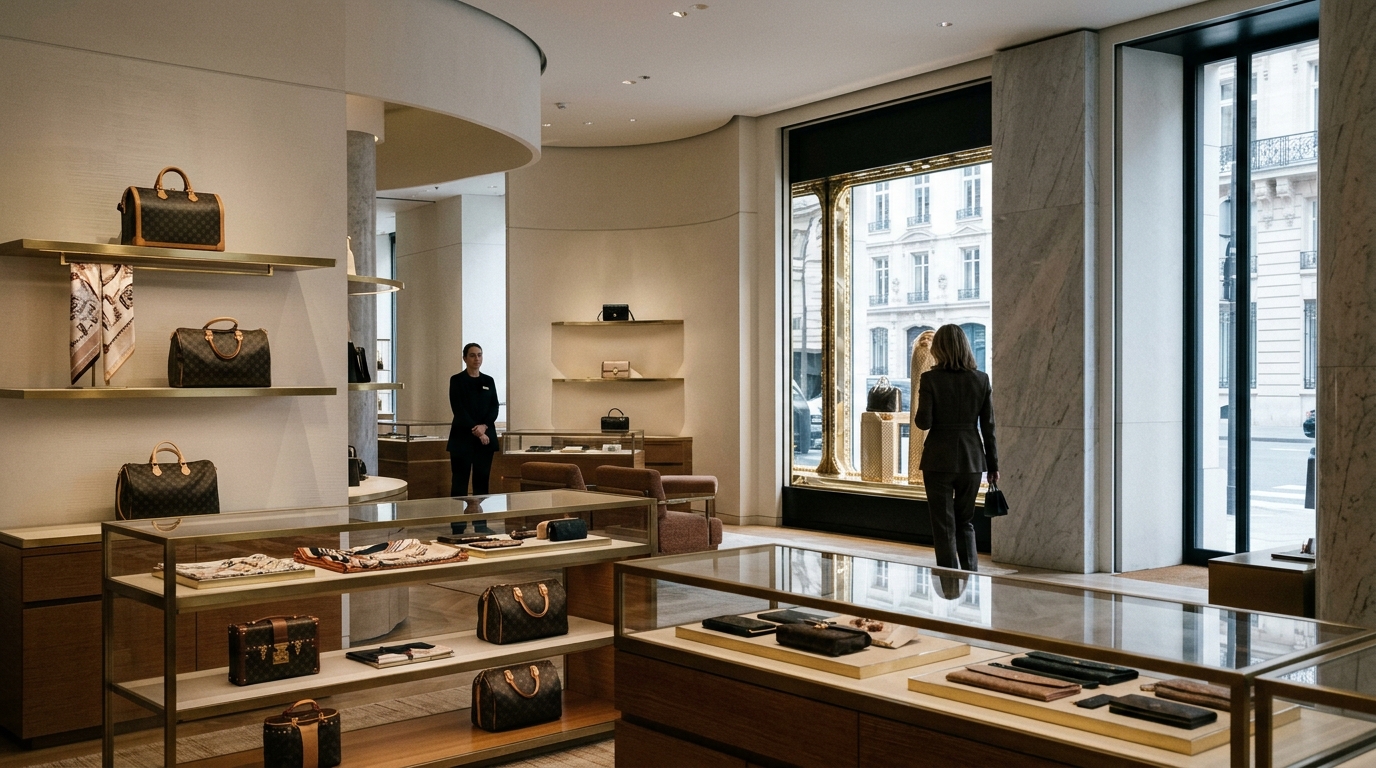
Results are out. €38.6 billion in H1 2026 revenue. Net profit flat at €5.7 billion. Operating margin holding at 22.5%. On paper, that beats the consensus. The stock is trading steady as of this morning.
And yet.
Here’s what’s actually happening inside those numbers, and why the headline miss-or-beat debate is the wrong thing to be watching right now.
The Quarter That Tells Two Stories
Fashion and Leather Goods — the division that accounts for roughly three-quarters of group recurring operating profit and houses Louis Vuitton, Dior, Celine, and Fendi — finally returned to organic revenue growth in Q2. One percent. After an extended stretch of weakness. That’s the good news, and LVMH is leaning into it hard.
But zoom out. Profit from recurring operations fell about 4% to €8.7 billion. Operating margin is 22.5%, flat with the prior year but well below the 26%-plus levels the group was posting during the post-pandemic surge. And the Fashion division’s revenue in H1 2026 was €18.1 billion, down from €19.4 billion a year earlier.
The numbers are stabilizing. They are not reaccelerating.
The Bifurcation Nobody Wants to Name
This is where the structural story gets interesting. Bain’s research with Altagamma has estimated that roughly 60–70 million luxury customers have been lost over the last two years as steep price hikes and a creativity transition reduced loyalty and pushed aspirational buyers out. That number is not coming back next quarter. It is a structural reset — the collapse of the entry-level luxury customer who bought a Dior card holder or a LV canvas bag when money was flowing and interest rates were zero.
In 2019, wealthy buyers accounted for about 30% of US personal luxury spending. By 2026, that figure has risen to roughly 46% to 47%. The middle of the market hollowed out. And LVMH, with its broad portfolio spanning entry-level cosmetics through five-figure Tiffany jewelry, sits directly across that fault line.
The contrast within LVMH’s own results makes this visible. Watches and Jewelry posted 9% organic growth in H1 2026, led by Tiffany and Bvlgari. Sephora’s selective retailing segment grew 5%. Wines and Spirits recovered 5% organically. But Fashion and Leather Goods — the engine — managed just 1% organic growth in Q2 after a 2% contraction in Q1. Meanwhile, demand for experiences is growing at about 1.5 times the rate of demand for physical luxury goods, according to the 2026 update of the Altagamma-Bain monitor.
The customer who buys a Bvlgari ring for a 30th anniversary is not the same customer who buys a LV monogram tote because they can. One of those customers is still spending. The other left two years ago and hasn’t returned.
The Portfolio Pruning Is Accelerating
LVMH has been doing something unusual for a company that built its empire through acquisition: selling things. In May, it agreed to sell Marc Jacobs to WHP Global, alongside G-III Apparel Group in the transaction structure. It had already divested its stake in Stella McCartney and Off-White. It is also reported to have explored a sale of its 50% stake in Rihanna-backed Fenty Beauty; reporting has suggested a valuation range around $1 billion to $2 billion. It has also agreed to sell its DFS airport concessions in Los Angeles and San Francisco, and to sell DFS Okinawa to Avolta.
The official framing is portfolio optimization. The more honest read: LVMH is shedding brands it cannot make work in a slower-growth environment, where scale is no longer automatically an advantage. The group is concentrating firepower around houses that can still command premium pricing, genuine scarcity, and ultra-high-net-worth loyalty — Louis Vuitton, Dior, Tiffany, Loewe, Celine.
That is a reasonable strategic call. It also implies that the era of LVMH buying everything in sight and growing through volume is behind it.
What Asia Tells You
China is the number everyone is triangulating. LVMH said Asia excluding Japan saw strong growth in H1 2026, confirming the improvement in trends observed starting in the second half of 2025. The company did not publish the specific +6% / +5% / +4% regional split in the H1 2026 press release; the message was simply that the US accelerated, Asia ex-Japan improved, Japan grew, and Europe was resilient.
None of those numbers are alarming. None of them justify the multiple that LVMH traded at when everything was going right either.
The stock spent most of Q1 2026 in freefall. It fell about 28% in the first three months of the year — the worst start to a year for the stock in Bloomberg data going back to 1989. It has since stabilized, trading around €490.
Technical Framework
The stock is trading below its 200-day moving average, which has been acting as resistance since the February breakdown. Free cash flow of €4.1 billion in H1 2026 is solid and supports the dividend and capital returns case. But momentum traders will want to see Fashion and Leather Goods sustain positive organic growth for at least two consecutive quarters before treating the Q2 result as a genuine inflection rather than a favorable comparison effect.
Key levels to monitor: The €480-490 range has been support since May. A sustained break below €460 would suggest the market is pricing in a second-half disappointment. A reclaim above the €520-530 zone — where the 200-day moving average sits — would shift the technical structure from neutral back to constructive.
Three Scenarios Heading Into H2
Bull Case: Fashion and Leather Goods sustains 2-3% organic growth through H2 as creative reboots at Dior and Loewe gain traction. China shows sequential improvement. Tiffany and Bvlgari keep the Watches and Jewelry momentum. Stock works toward €540-560 as margins stabilize. Catalyst: strong Q3 revenue release in October with improving China commentary.
Base Case: Low-single-digit organic growth continues across the portfolio. Currency headwinds persist, keeping reported revenue roughly flat year-over-year. The operating margin holds near 22%. Stock trades in the €480-510 range, with upside capped by valuation skepticism and downside cushioned by the dividend and cash flow floor. No re-rating until there is evidence of a sustained aspirational consumer return.
Bear Case: China demand stalls or reverses, erasing the Asia recovery story. Fashion and Leather Goods reverts to negative organic growth in Q3 as the comparison period normalizes and creative transition costs mount at Dior. Middle East conflict escalation further crimps tourism spending. Operating margin falls below 21%. Stock tests the €440-460 area last seen in early spring. Catalyst: a weak Q3 revenue read combined with downward guidance revision on currency.
What Active Traders Are Watching
There are two near-term catalysts that matter. First, the Kering and Hermes results later this week — both report shortly after LVMH and will confirm whether the cautious recovery seen in LVMH’s numbers is sector-wide or LVMH-specific. If Hermes posts another strong quarter while LVMH flatlines, the divergence story gets a lot louder.
Second, the Q3 revenue release in October will be the real verdict on H2. By then, the creative direction changes at Celine, Dior, Givenchy, and Fendi will have had another full season to show up in sell-through data. The question is whether brand heat converts to revenue before currency and margin pressure completes another leg lower.
The €4.1 billion in free cash flow means LVMH is not distressed. The 22.5% operating margin means it is not broken. But the stock has been revalued for a world where aspirational luxury is a smaller business than it was in 2021 and 2022. Whether that reset is complete — or whether it has further to run — depends on which consumer actually shows up in the second half.
The data from today says the floor is holding. It does not yet say the ceiling is back.
For informational and educational purposes only. Not investment advice. Trading involves risk, including loss of principal.