
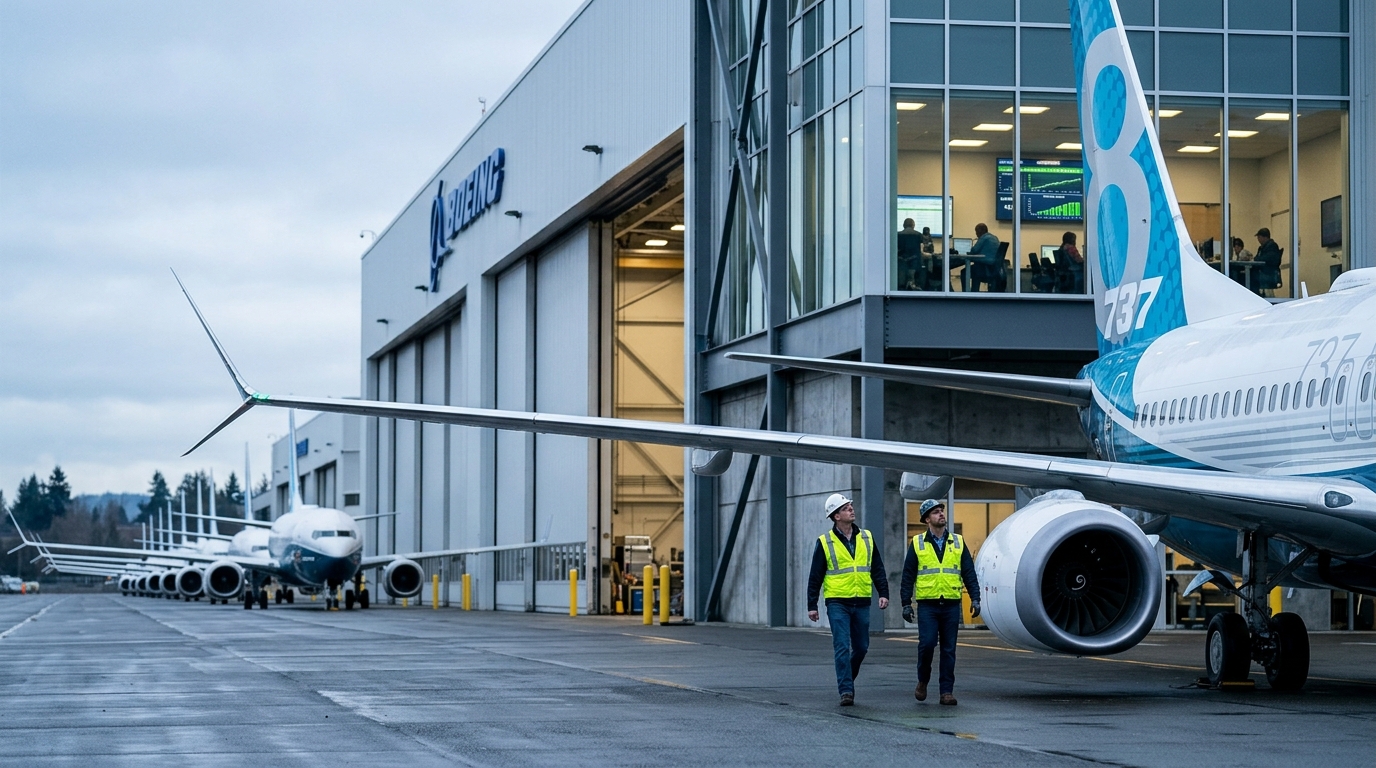
Here is the thing about Boeing right now. The stock is down about 4% this year and roughly 11% over the past twelve months. Its 52-week range runs from $176.77 to $254.35. It is sitting near $210 today, a full $45 below where it was trading in January. And this morning, Q2 2026 earnings hit the wires before the open.
The numbers Wall Street is watching: a loss of roughly $0.34 per share on revenue of approximately $24.05 billion. That would represent a loss narrowing of about 73% year over year compared to the $1.24 loss posted in Q2 2025.
That framing matters. This is not a story about whether Boeing is profitable. It is a story about how fast the losses are shrinking and whether cash flow is turning positive on schedule.
What Q1 Already Told You
Q1 was the roadmap. Boeing posted a loss of just $0.20 per share in the first quarter. Revenue climbed 14% year over year to $22.2 billion. Commercial deliveries rose to 143 aircraft from 130 in the same quarter a year earlier. Defense, Space and Security revenue jumped 21% to $7.6 billion.
The debt paydown is the part most people skipped. Boeing ended Q1 with total debt of $47.2 billion, down from $54.1 billion at the end of 2025. That is not noise. That is structural progress.
Slight tangent, but it matters here: Boeing also closed Q1 with a $695 billion backlog. That is larger than the combined order books of Lockheed Martin and RTX combined. The market cap sits near $165 billion. You do not need a complicated model to understand what that ratio implies.
The Q2 Delivery Count
Boeing delivered 171 commercial airplanes in Q2 2026, up meaningfully from Q1. The 737 and 787 Dreamliner led the quarter.
787 seat certification delays remain a headwind. Not resolved yet. Worth watching in guidance commentary.
On the defense side, the backdrop is getting louder. The FY2027 Department of War budget totals roughly $1.45 trillion, a 44% annual increase. Air power funding is slated for growth.
The Free Cash Flow Question
Full-year 2026 guidance calls for positive free cash flow of $1.0 to $3.0 billion. That would be the first positive FCF year for Boeing in a long time. If Q2 results support that trajectory, the options market will have to reprice the story.
Right now, options traders are pricing a ±6.06% move post-earnings. That is above Boeing’s average four-quarter post-earnings swing of 3.95%. The market is expecting something meaningful to happen today, in either direction.
Options Framework
With implied volatility elevated ahead of the report, premium is rich. A beat that confirms the FCF trajectory and accelerating deliveries could send BA toward the $220 to $230 range. A miss or weaker-than-expected guidance would put $195 to $200 back in play.
Analyst consensus sits at $270.08 against today’s price near $210, with 21 buy ratings and one sell. The gap between where the stock is and where analysts think it belongs is hard to ignore.
- Bull case: FCF positive in Q2, delivery acceleration confirmed, 787 certification progress. BA re-rates toward analyst consensus.
- Bear case: FCF still negative, 787 delays worsen, China deal uncertainty resurfaces. Stock retests $190 to $195 zone.
- Neutral/defined-risk structure: For traders expecting a large move but uncertain direction, a short straddle or strangle captures elevated IV crush post-earnings. Risk is unlimited on a tail move. A defined-risk iron condor with wings at $190 and $230 limits exposure while collecting the vol premium.
What to Watch
Three numbers will move this stock today: free cash flow guidance language, the pace of 737 production increase toward the 47-per-month target, and any update on the 777X timeline. Everything else is noise.
Boeing was the best industrial story of 2025 when the turnaround thesis was pure speculation. Now it has data behind it. The question is whether the market is willing to pay for a company that is still losing money but shrinking those losses faster than expected. That answer comes this morning.